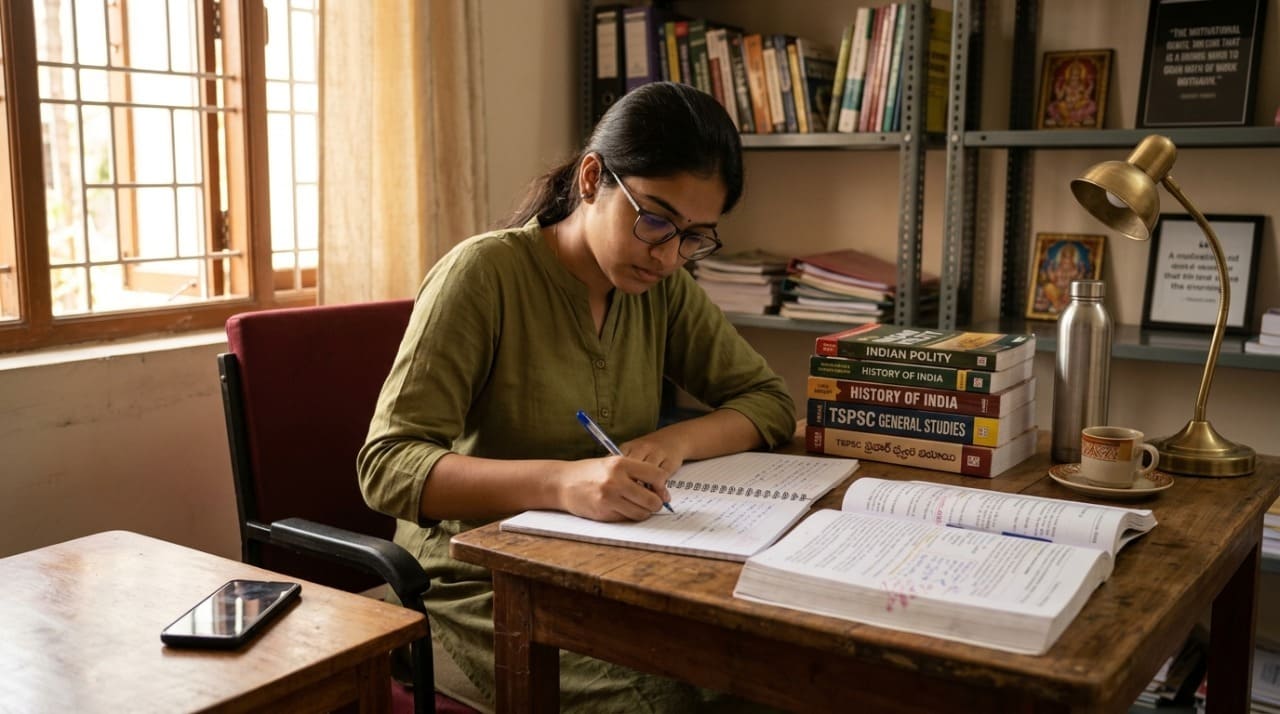
Let us be honest. Most aspirants do not lose the battle because they lack intelligence. They lose it because their attention is constantly stolen. You sit to study one chapter, unlock your phone for “just two minutes,” and suddenly forty minutes are gone. One reel becomes ten. One notification becomes a chat. One quick news update becomes a full scrolling session. By the time you return to your book, your focus is broken and guilt has already entered your mind.
This is why digital detox is not a luxury for competitive exam aspirants. It is a preparation strategy. For TSPSC aspirants, where the syllabus is vast and the competition is serious, your ability to sit with one topic for long, uninterrupted periods can become your biggest advantage.
Digital detox does not mean throwing away your phone or deleting the internet from your life. That is not practical. As an aspirant, you may need online classes, PDFs, current affairs, mock tests, and discussion groups. The goal is not to reject technology. The goal is to stop technology from controlling you.
In this blog, we will discuss how to stop scrolling and start studying using practical, realistic methods that actually work for students preparing from home, hostels, libraries, and coaching centers.
Why Scrolling Feels So Addictive
Before solving the problem, you need to understand it. Scrolling is addictive because it gives your brain quick rewards. Every reel, short video, meme, notification, or post gives a small hit of novelty. Your brain enjoys the surprise: “What comes next?” That uncertainty keeps you hooked.
Studying, on the other hand, gives delayed rewards. You may study the Indian Constitution today, but the result may come after months. You may revise Telangana history now, but the marks will come only in the exam. So your brain naturally prefers the immediate pleasure of scrolling over the slow satisfaction of learning.
This does not mean you are lazy. It means your environment is designed against your focus. Apps are built to keep you engaged. Notifications are designed to pull you back. Infinite scrolling is designed to make stopping difficult.
As a serious aspirant, your job is to redesign your environment so that studying becomes easier and distraction becomes harder.
The Real Cost of “Just 10 Minutes”
Many students say, “Sir, I only use Instagram for 10 minutes.” But the real damage is not just those 10 minutes. The bigger damage is the attention residue it leaves behind. After watching fast-moving content, your mind struggles to adjust to slow reading. A Polity chapter feels boring. A history topic feels heavy. A long answer feels impossible.
This is why you may physically sit with books for six hours but effectively study only two hours. Your body is present, but your mind is still moving between notifications, videos, comments, and random thoughts.
Ask yourself honestly:
- Do you check your phone immediately after waking up?
- Do you open social media between every study session?
- Do you feel restless when your phone is away?
- Do you study with your phone beside your notebook?
- Do you sleep late because of scrolling?
- Do you feel guilty after wasting time online?
If your answer is yes to most of these, you do not need motivation first. You need a system.
Digital Detox Is Not About Willpower
Many aspirants think, “From tomorrow, I will control myself.” But willpower alone is weak. It works for one day, maybe two days. Then stress comes, boredom comes, or a difficult topic comes, and the phone becomes an escape.
A better approach is to create rules that reduce decision-making. You should not fight your phone every five minutes. You should design your day in such a way that the phone is not constantly available.
Remember this line: Do not depend on self-control when you can depend on structure.
If your phone is beside you, unlocked, with notifications on, apps easily accessible, and internet active, you are making studying unnecessarily difficult. A disciplined student is not someone who never feels distracted. A disciplined student is someone who removes distractions before they attack.
Step 1: Identify Your Biggest Digital Triggers
Digital detox starts with awareness. For one day, observe your phone usage without judging yourself. Notice when and why you pick up your phone.
Common triggers include:
- Boredom: You open your phone when a topic feels dry.
- Difficulty: You escape when you cannot understand a concept.
- Stress: You scroll when you feel exam pressure.
- Loneliness: You check messages to feel connected.
- Habit: You unlock your phone without any reason.
- Reward-seeking: You scroll after completing a small study task.
Once you identify your trigger, you can create a better response. For example, if you scroll when a topic becomes difficult, your new rule can be: “When I feel stuck, I will write the doubt in my notebook and continue for 15 more minutes before touching the phone.”
Step 2: Create a Phone-Free First Hour
The first hour after waking up decides the tone of your day. If you begin with reels, messages, news alerts, and random videos, your mind becomes scattered before study even starts. But if you begin with quiet reading, revision, or planning, your brain enters study mode early.
Make this rule: No phone for the first 60 minutes after waking up.
Use this hour for simple but powerful activities:
- Revise yesterday’s notes
- Read one newspaper editorial or current affairs topic
- Write your daily study targets
- Practice 10 Polity or Telangana history MCQs
- Review one short topic from memory
This one habit can change your preparation. You will start your day with ownership instead of reaction. You will stop giving your freshest mental energy to social media.
Step 3: Keep Your Phone Physically Away While Studying
Keeping the phone face down on the table is not enough. Keeping it on silent is also not enough. Your brain knows it is there. Even without notifications, the urge to check remains.
During study sessions, keep your phone:
- In another room
- Inside a bag
- With a family member
- In a locked drawer
- At the library counter, if allowed
The rule is simple: Your phone should not be within arm’s reach during deep study.
If you use your phone for lectures, then make it a single-purpose device during that time. Turn on airplane mode if internet is not needed. If internet is needed, close all other apps and keep only the class or study material open.
Step 4: Use the 45-10 Study Method
Many students fail because they try to study for five hours continuously and then collapse into scrolling. Instead, use a sustainable method.
Try this pattern:
- 45 minutes: Deep study with no phone
- 10 minutes: Break without social media
- Repeat: 3 to 4 cycles
During the 10-minute break, do not open reels or short videos. They will destroy your next session. Instead, walk, drink water, stretch, close your eyes, or revise flashcards. The break should refresh your brain, not hijack it.
If 45 minutes feels difficult in the beginning, start with 25 minutes. But slowly train your brain to sit longer. Competitive exams reward students who can focus deeply.
Step 5: Replace Scrolling With a Better Reward
You cannot remove a habit without replacing it. If scrolling is your reward after studying, you need a healthier reward.
Better rewards include:
- Tea or coffee break
- Short walk outside
- Listening to one calm song
- Talking to a friend for five minutes
- Eating a fruit or snack
- Marking a completed task on your planner
Do not underestimate the satisfaction of ticking off tasks. A visible progress tracker gives your brain a clean reward. Every completed chapter, mock test, and revision slot should be marked. This builds confidence.
Step 6: Turn Your Phone Into a Study Tool, Not a Distraction Machine
Your phone is not the enemy. Uncontrolled usage is the enemy. Use technology with clear boundaries.
Here are practical changes you can make today:
- Remove social media apps from your home screen
- Turn off all non-essential notifications
- Use grayscale mode to make your phone less attractive
- Log out of distracting apps after each use
- Use app timers for social media
- Keep only study apps visible
- Use website blockers during study hours
- Mute unnecessary WhatsApp and Telegram groups
For TSPSC preparation, your phone should mainly support:
- Online classes
- Current affairs updates
- Mock tests
- PDF reading
- Doubt clarification
- Revision apps or flashcards
Everything else should have a time limit.
Step 7: Fix Specific Social Media Windows
Complete social media removal may not work for everyone. Some students delete apps, reinstall them after three days, and then binge-scroll for hours. A better method is controlled access.
Set one or two fixed social media windows in a day. For example:
- 15 minutes after lunch
- 20 minutes after dinner
Do not use social media before study sessions, during breaks, immediately after waking up, or just before sleeping. These are danger zones.
The most important rule: Never use social media as a break between two study sessions. It does not relax your mind. It overstimulates it.
Step 8: Protect Your Sleep From the Phone
Late-night scrolling is one of the biggest enemies of exam preparation. It reduces sleep quality, delays waking time, weakens memory, and increases anxiety. Many aspirants do not have a study problem; they have a sleep problem created by phone usage.
Create a digital sunset rule: No phone for the last 45 minutes before sleep.
Use that time for:
- Light revision
- Planning the next day
- Reading a physical book
- Writing mistakes from mock tests
- Meditation or breathing practice
Keep your phone away from your bed. Use a normal alarm clock if needed. Charging your phone near your pillow is an invitation to late-night scrolling.
Step 9: Build a Study Environment That Pulls You In
Your environment should silently push you toward study. Keep your desk clean and ready. Before sleeping, arrange the next morning’s books, notebook, pen, water bottle, and target list. When you wake up, the setup should invite you to start.
A good study environment includes:
- A clean desk
- Only the required book for the current session
- A written daily target sheet
- A water bottle
- A clock or timer
- No phone on the table
- No unnecessary tabs open on laptop
Clutter creates mental resistance. A clean desk reduces excuses.
Step 10: Use the “One Page Before Phone” Rule
This is a simple but powerful rule. Every time you feel like checking your phone during study hours, tell yourself: “I will read one more page before touching the phone.”
Most of the time, after reading one page, the urge reduces. Even if you still check your phone later, you have trained your brain to delay the impulse. This is how discipline is built — not through dramatic promises, but through small repeated victories.
A Practical Digital Detox Timetable for Aspirants
Here is a realistic model you can adjust according to your routine:
- 6:00 AM: Wake up, no phone
- 6:15 AM – 7:15 AM: Revision or MCQs
- 7:15 AM – 7:30 AM: Check important messages only
- 8:30 AM – 11:30 AM: Deep study blocks, phone away
- 11:30 AM – 11:45 AM: Controlled phone window
- 12:00 PM – 2:00 PM: Subject study or class
- 3:30 PM – 5:30 PM: Practice tests or answer writing
- 6:00 PM – 6:30 PM: Walk or exercise, no scrolling
- 7:00 PM – 9:00 PM: Revision and current affairs
- 9:15 PM – 9:35 PM: Final phone window
- 10:00 PM onwards: No phone, sleep preparation
This timetable is not compulsory. The principle is important: study first, phone later. Your phone should be a scheduled activity, not a constant interruption.
What to Do When You Relapse
You will make mistakes. One day you may scroll for two hours. Another day you may break your own rules. Do not convert one bad day into a bad week.
When you relapse, do this:
- Do not insult yourself
- Write what triggered the scrolling
- Restart with one 25-minute study session
- Keep the phone away immediately
- Sleep on time that night
Consistency does not mean perfection. It means returning quickly after distraction.
Final Mentor Advice: Your Attention Is Your Real Capital
Dear aspirant, in competitive exam preparation, time is important, but attention is even more important. Two hours of focused study can be more valuable than six hours of distracted sitting. The student who protects attention every day slowly becomes stronger than the student who only collects books, PDFs, and strategies.
Digital detox is not punishment. It is freedom. Freedom from guilt. Freedom from comparison. Freedom from random content. Freedom to build the life you actually want.
You do not need to disappear from the digital world. You only need to stop being controlled by it. Start small. Keep your phone away for one study session today. Then do it again tomorrow. Build one clean morning. Then one clean evening. Slowly, your focus will return.
Your next task: For the next 24 hours, follow only three rules: no phone for the first hour after waking up, no phone on the study table, and no phone for 45 minutes before sleep. These three rules alone can give you a strong beginning.
Stop scrolling for a while. Your future self is waiting on the other side of focused study.