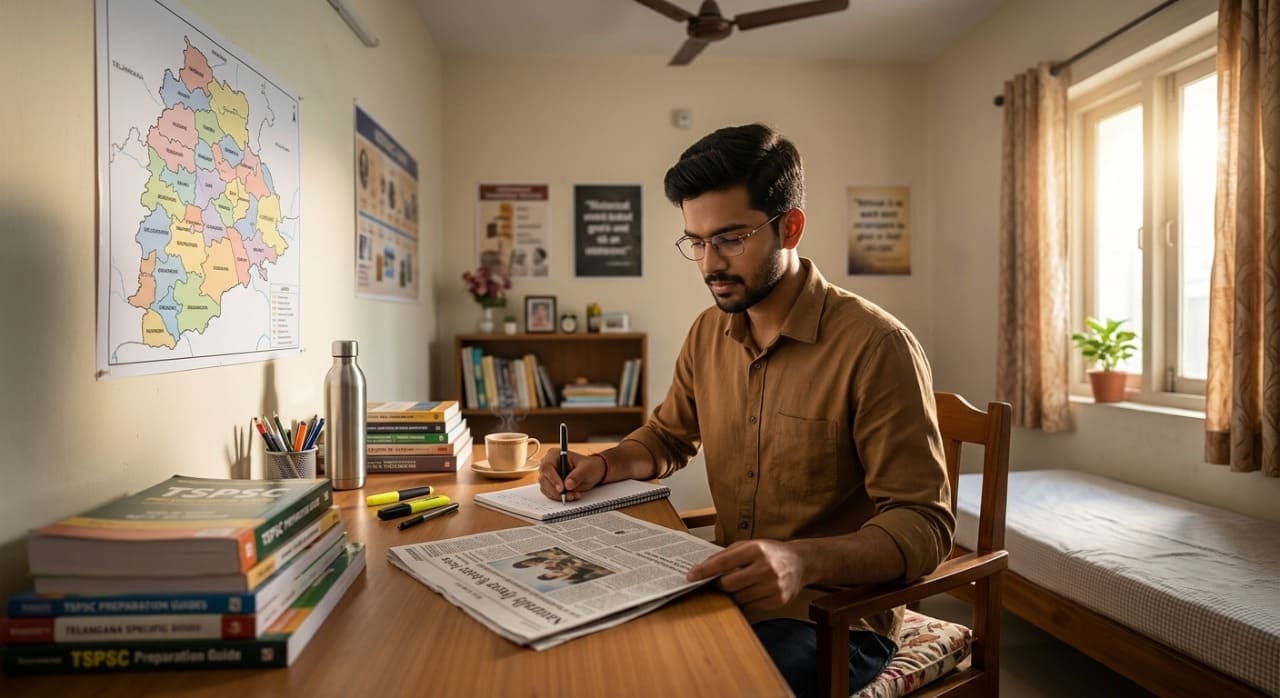
Why Newspaper Reading Matters So Much for TSPSC Aspirants
For many TSPSC aspirants, newspaper reading feels confusing in the beginning. You open the paper with full motivation, but after a few pages, every article starts looking important. Politics, schemes, editorials, economy, environment, Telangana issues, international news, sports, court judgments — the list feels endless. By the time you finish reading, two hours are gone, and you are still unsure what to remember.
Let me tell you something very clearly: newspaper reading for TSPSC is not general reading; it is exam-oriented reading. You are not reading like a journalist, political analyst, or casual reader. You are reading like a future Telangana public servant. That means your goal is to understand governance, society, economy, public policy, Telangana development, constitutional values, and issues affecting people.
In TSPSC exams, current affairs are not asked only as direct questions. They also appear indirectly in Polity, Economy, Telangana Movement, Society, Environment, Science and Technology, and even in essay-type Mains answers. A smart aspirant uses the newspaper not just to collect facts, but to build context, examples, and analytical ability.
The Biggest Mistake Aspirants Make While Reading Newspapers
The biggest mistake is trying to read the newspaper from the first page to the last page like a school textbook. This is not required. In fact, it is harmful because it consumes time and creates unnecessary pressure.
You must remember this rule: TSPSC does not reward the person who reads the most pages; it rewards the person who understands the most relevant issues.
Another common mistake is cutting every article, making bulky notes, or copying full news reports into notebooks. This gives a false feeling of productivity. But during revision, such notes become impossible to revise. The topper’s approach is different: read selectively, note briefly, revise regularly, and connect everything to the syllabus.
Which Newspaper Should You Read for TSPSC?
For TSPSC preparation, one good English newspaper or one good Telugu newspaper is enough, depending on your comfort. Many aspirants prefer English newspapers because editorials help in improving analytical writing for Mains. Telugu newspapers are also useful, especially for understanding local Telangana issues, government schemes, regional development, irrigation projects, agriculture problems, social issues, and state politics.
You do not need to read three newspapers every day. That will only confuse you. Choose one main newspaper and use monthly current affairs compilations from a trusted platform like CrackSarkar for consolidation.
A practical combination
- Daily newspaper: For understanding issues and building awareness.
- Monthly current affairs: For revision and exam-oriented facts.
- TSPSC syllabus: For deciding what to read and what to ignore.
- Previous year questions: For understanding the exam pattern and importance areas.
Start with the TSPSC Syllabus Before Opening the Newspaper
This is the real secret. Before you read the newspaper, you must know what TSPSC wants from you. Keep the syllabus beside you, at least during the first few weeks. Slowly, your mind will automatically start filtering relevant information.
For example, if you see news about irrigation projects in Telangana, it is relevant because it connects with Telangana economy, agriculture, geography, governance, and development. If you see news about a constitutional amendment, court judgment, or Governor-state government relations, it connects with Indian Polity. If there is news about inflation, unemployment, budget, RBI, or welfare spending, it connects with Economy.
This habit changes everything. Instead of asking, “Is this news important?”, ask: “Which part of the TSPSC syllabus does this news connect to?” If there is no connection, move on.
The 60-Minute Newspaper Method for TSPSC
Newspaper reading should not take your whole morning. For most aspirants, 45 to 60 minutes is enough if done properly. Beginners may take a little longer, but the goal should be to reduce time gradually.
Step 1: First 5 minutes — Scan the headlines
Do not start reading deeply immediately. First, scan the front page, national page, state page, economy page, editorial page, and science or environment-related items. Mark mentally what looks relevant. Avoid crime news, political gossip, celebrity news, routine party statements, and sensational stories unless they connect to governance or policy.
Step 2: Next 20 minutes — Read Telangana and national issues
For TSPSC, Telangana-related news deserves special attention. Focus on government schemes, budget allocations, irrigation, agriculture, tribal welfare, education, health, urban development, rural development, women and child welfare, social justice, and district-level initiatives.
National issues are also important, especially those related to Parliament, Supreme Court judgments, constitutional bodies, federalism, environment, economy, science and technology, internal security, and social issues.
Step 3: Next 20 minutes — Read editorials and explained articles
Editorials are not for memorizing. They are for developing understanding. Many aspirants skip editorials because they feel difficult. But editorials help you write better answers in Mains. They teach you how to present arguments, use examples, and examine both sides of an issue.
Read only one or two editorials per day. Choose topics linked to governance, economy, social justice, environment, education, health, agriculture, technology, or constitutional issues. Do not waste time on purely political opinion pieces with no exam value.
Step 4: Last 10 minutes — Make micro-notes
Do not copy full articles. Write short, revision-friendly notes. Your note should answer four questions: What happened? Why is it important? Which syllabus area does it connect to? What fact, example, or argument can I use in the exam?
For example, if there is news about a Telangana irrigation project, your note can be: “Irrigation project update — relevant for Telangana economy, agriculture, regional development, water management. Use as example in Mains answers on rural development and drought mitigation.”
What to Read and What to Skip
Selection is the heart of effective newspaper reading. A disciplined aspirant knows what to ignore. This saves time and protects mental energy.
Read these carefully
- Telangana-specific news: schemes, policies, budget, welfare, agriculture, irrigation, education, health, employment, districts, culture, heritage, and social issues.
- Government schemes: objectives, target groups, implementation challenges, and relevance to citizens.
- Polity and governance: Parliament, state legislature, judiciary, constitutional bodies, federal relations, local governance, rights, and public administration.
- Economy: inflation, unemployment, budget, taxation, agriculture, industry, banking, poverty, welfare, and development indicators.
- Environment: climate change, biodiversity, pollution, conservation, forests, wildlife, sustainable development, and disaster management.
- Science and technology: space, biotechnology, digital governance, AI, health science, defence technology, and innovations useful for society.
- Social issues: gender, caste, education, health, poverty, migration, urbanization, elderly, children, and vulnerable groups.
- Reports and indices: national and international reports related to development, health, education, economy, environment, and governance.
Skip these mostly
- Daily political accusations and counter-accusations.
- Routine crime stories without policy relevance.
- Celebrity news and entertainment gossip.
- Sports match details, unless linked to awards, policies, or major national relevance.
- Local accidents, unless connected to disaster management or public safety policy.
- Stock market daily fluctuations, unless linked to broader economic concepts.
How to Make Notes from the Newspaper
Your newspaper notes should be short enough to revise and strong enough to use in the exam. Many aspirants make the mistake of creating beautiful notes that they never revise. Remember: notes are not for decoration; notes are for recall.
Use a simple structure. Divide your current affairs notebook or digital document into categories such as Telangana, Polity, Economy, Environment, Science and Technology, Social Issues, Government Schemes, Reports and Indices, and Important Personalities or Awards.
The 5-line note-making formula
- Topic: Name of the issue.
- Context: What happened recently?
- Static link: Which syllabus topic does it connect to?
- Exam value: Prelims fact, Mains example, or interview opinion.
- One-line takeaway: Your final understanding in simple words.
For example, suppose the newspaper reports on urban flooding in Hyderabad. Your note can include the causes, such as poor drainage, encroachment of lakes, rapid urbanization, and climate variability. Then connect it to urban governance, disaster management, environmental conservation, and Telangana development. In Mains, this can become a strong example for questions on urban planning.
How to Read Editorials for TSPSC Mains
Editorials are powerful, but only if you read them actively. Do not underline every line. Do not memorize the writer’s opinion blindly. Instead, break the editorial into useful parts.
Ask yourself: What is the issue? What are the causes? Who is affected? What are the constitutional, economic, social, or ethical dimensions? What solutions are suggested? Can I use this in a Mains answer?
Editorial reading checklist
- Identify the central issue in one sentence.
- Write two causes or background points.
- Write two consequences or challenges.
- Note one data point, committee, judgment, or example if available.
- Write a balanced conclusion in your own words.
This method slowly improves your answer-writing skill. After a few months, you will notice that you are able to write richer answers with examples, balanced arguments, and better introductions.
How to Connect Newspaper Reading with Static Subjects
This is where serious aspirants gain an edge. Current affairs and static subjects should not be studied separately. They should support each other.
For example, when you read about a Supreme Court judgment, revise the related constitutional article, fundamental right, or directive principle. When you read about inflation, revise demand-pull inflation, cost-push inflation, RBI monetary policy, and impact on poor households. When you read about a Telangana welfare scheme, connect it with social justice, inclusive growth, and state economy.
This approach gives you double benefit. You remember current affairs better because they are connected to concepts. You also understand static subjects better because you see their real-life application.
Daily, Weekly, and Monthly Revision Plan
Reading the newspaper daily is useful only when you revise. Without revision, current affairs becomes a leaking bucket. You keep adding information, but most of it disappears before the exam.
Daily revision
At the end of newspaper reading, spend five minutes reviewing what you noted. Try to recall the main issue without looking. This small habit improves memory.
Weekly revision
Every Sunday, revise the week’s notes. Remove duplicate points. Highlight the most important topics. Convert long notes into shorter points. Attempt five to ten MCQs from the week’s current affairs.
Monthly revision
At the end of every month, use a reliable current affairs compilation to fill gaps. Compare it with your notes. Do not try to memorize everything in one day. Revise category-wise: Telangana one day, Economy another day, Polity another day, and so on.
How Beginners Should Start Without Feeling Overwhelmed
If you are new to TSPSC preparation, do not expect perfection from day one. For the first two weeks, simply focus on building the habit. Read headlines, Telangana news, and one editorial. That is enough to begin.
After two weeks, start making short notes. After one month, begin connecting news with syllabus topics. After two months, start using newspaper examples in answer writing. Growth should be gradual and sustainable.
Do not compare your newspaper notes with others. Some aspirants will show thick notebooks, dozens of cuttings, and hundreds of highlighted PDFs. That does not mean they are ahead. The real test is simple: Can you revise your notes before the exam and use them in answers?
Common Myths About Newspaper Reading
Myth 1: I must read the entire newspaper
No. You must read only what is relevant to the exam. Selective reading is not laziness; it is strategy.
Myth 2: English newspaper is compulsory
No. Read in the language you understand best. However, if you are preparing for Mains in English, editorials can help improve vocabulary and expression. If you are more comfortable in Telugu, use Telugu newspapers and gradually build answer-writing language separately.
Myth 3: Making long notes means better preparation
No. Long notes often become difficult to revise. Short, structured, syllabus-linked notes are far more useful.
Myth 4: Current affairs can be prepared only before the exam
This is risky. Current affairs needs repeated exposure. Last-minute compilations help, but they cannot replace regular understanding.
A Sample Daily Newspaper Routine for TSPSC Aspirants
- 6:30 AM – 6:35 AM: Scan headlines and mark relevant pages.
- 6:35 AM – 6:55 AM: Read Telangana and national governance-related news.
- 6:55 AM – 7:15 AM: Read one editorial or explained article.
- 7:15 AM – 7:25 AM: Make short notes under syllabus categories.
- Night revision: Spend five minutes recalling the day’s three most important issues.
This routine is simple, but if followed consistently for six months, it can transform your preparation. The key is not intensity for one week; the key is consistency for many months.
Final Mentor Advice: Read Like an Officer, Not Like a News Consumer
As a TSPSC aspirant, your newspaper reading should build the mindset of a public servant. Whenever you read an issue, think beyond facts. Ask: How does this affect people? What should the government do? What are the challenges in implementation? How can Telangana improve outcomes? What constitutional values are involved?
This is the difference between ordinary reading and exam-oriented reading. Ordinary readers react to news. Serious aspirants analyze news. Future officers think about solutions.
So from tomorrow, do not fear the newspaper. Do not treat it as a burden. Treat it as your daily training ground. Every relevant article is helping you understand society. Every editorial is improving your thinking. Every note is becoming a tool for Prelims, Mains, and interview.
At CrackSarkar, we always remind aspirants of one practical truth: small daily habits create big exam results. Newspaper reading is one such habit. Do it smartly, revise regularly, connect it with the syllabus, and use it in your answers. Over time, you will not just become better at current affairs — you will start thinking like the officer you are preparing to become.