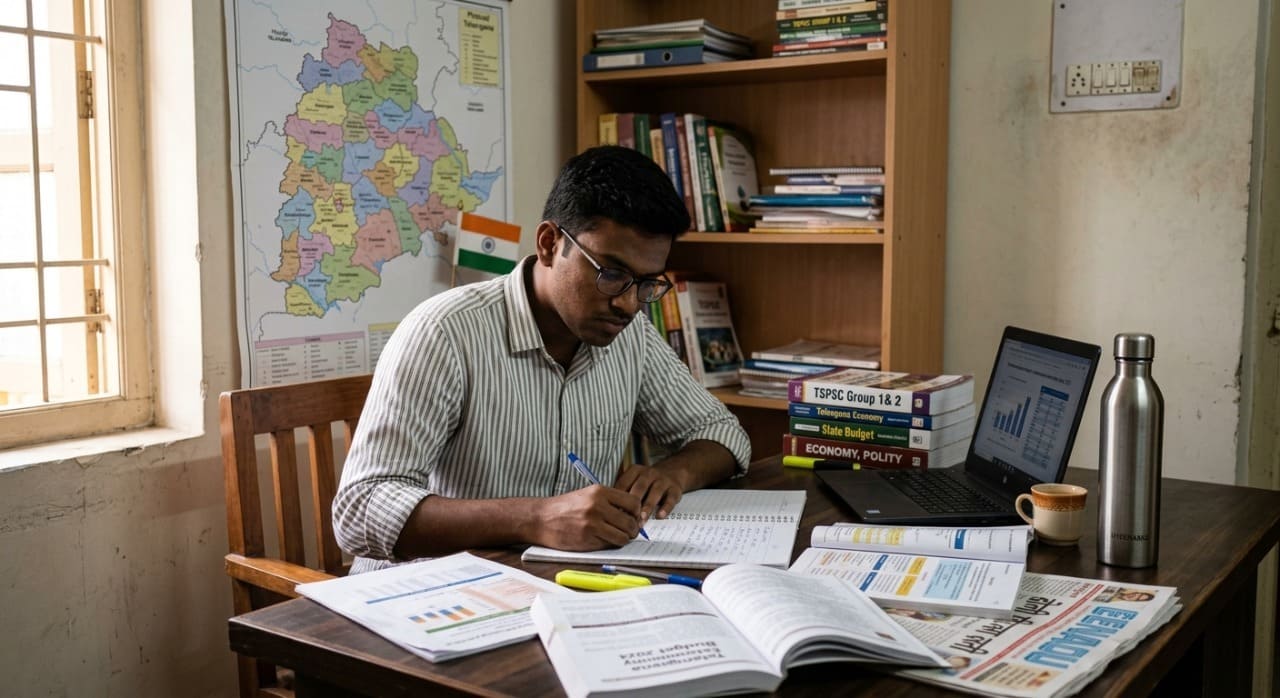
Why Telangana Economy Is a High-Scoring Area in TSPSC
For many TSPSC aspirants, Economy feels like a difficult subject. Terms like GSDP, fiscal deficit, inflation, capital expenditure, per capita income, primary sector, subsidies, and public debt may look technical at first. But here is the good news: Telangana Economy is one of the most scoring areas if you study it systematically.
Unlike abstract theory, Telangana Economy is closely connected to real life. Agriculture, irrigation, welfare schemes, employment, industries, IT sector, urban development, rural livelihoods, state budget, and regional development are all part of the subject. These are not just textbook topics; they are issues you see in newspapers every day.
In TSPSC exams, Telangana Economy is important for Prelims, Mains, and interview. In Prelims, questions may test factual clarity, schemes, sectors, budget terms, reports, and basic economic concepts. In Mains, you may be asked to explain Telangana’s development model, agricultural challenges, industrial growth, irrigation impact, welfare expenditure, unemployment, poverty, regional inequalities, or the role of the service sector.
The mistake most aspirants make is reading Telangana Economy randomly. They read one chapter from a textbook, then jump to budget highlights, then copy newspaper articles, then memorize schemes without understanding. This creates confusion. The right method is different: first build concepts, then study Telangana-specific data and issues, then connect everything with current affairs and answer writing.
First Understand What TSPSC Expects from Telangana Economy
Before opening any book, ask a simple question: What does TSPSC want to test through Telangana Economy? The answer is not just facts. The exam wants to test whether you understand the economic structure of Telangana, its strengths, challenges, policies, and development priorities.
You should be able to answer questions like: What are the major sectors of Telangana’s economy? Why is irrigation important for the state? What is the role of agriculture in rural livelihoods? Why is Hyderabad important for the service sector? What are the challenges faced by farmers, workers, youth, women, and small industries? How do welfare schemes affect inclusive growth? What is the significance of the state budget?
When you study with these questions in mind, Telangana Economy becomes meaningful. You stop memorizing isolated points and start building exam-ready understanding.
The Three-Layer Strategy for Telangana Economy
To score maximum marks, follow a three-layer approach. This is the most practical method for TSPSC aspirants.
Layer 1: Basic economic concepts
You cannot understand Telangana Economy without basic economy concepts. For example, if you do not understand GSDP, sectoral contribution, fiscal deficit, inflation, subsidies, capital expenditure, and revenue expenditure, budget and survey documents will feel difficult.
Start with basic concepts in simple language. Do not go too deep into advanced economics. TSPSC does not expect you to become an economist. It expects you to understand public policy and development issues.
Layer 2: Telangana-specific economy
Once basics are clear, study Telangana’s economic structure. Focus on agriculture, irrigation, industries, IT sector, services, welfare schemes, employment, rural development, urbanization, budget, and district-level development.
This is where you must connect the subject with Telangana’s geography, society, history, and governance. Telangana Economy is not separate from Telangana society. Issues like dryland agriculture, tank irrigation, migration, Hyderabad’s growth, rural livelihoods, tribal areas, and regional inequalities are deeply connected.
Layer 3: Current affairs and answer writing
The final layer is application. Use newspapers, government reports, budget speeches, Economic Survey or Socio-Economic Outlook documents, and current affairs compilations to update your preparation. Then practice writing answers using examples, data points, schemes, and balanced analysis.
Start with the Syllabus: Your Best Filter
The TSPSC syllabus should be your guide. Many aspirants waste time because they read everything available on Telangana Economy. That is not required. Your preparation should be syllabus-driven.
Make a checklist of broad topics and keep it near your study table. Whenever you read a chapter, newspaper article, or budget point, connect it to one of these areas.
Important Telangana Economy areas for TSPSC
- Structure of Telangana economy: Primary, secondary, and tertiary sectors.
- Agriculture: Cropping pattern, irrigation, farmers’ issues, agricultural policies, allied sectors.
- Irrigation and water resources: Projects, tanks, groundwater, water management, impact on agriculture.
- Industry: Industrial policies, MSMEs, manufacturing, pharma, textiles, food processing, industrial corridors.
- Service sector: IT, ITES, tourism, real estate, trade, transport, financial services, Hyderabad’s role.
- State budget: Revenue, expenditure, welfare spending, capital expenditure, fiscal management.
- Welfare and inclusive growth: Schemes for farmers, women, SCs, STs, BCs, minorities, elderly, and vulnerable groups.
- Employment and skill development: Youth employment, informal sector, migration, entrepreneurship.
- Poverty and inequality: Regional disparities, rural-urban divide, social sector development.
- Infrastructure: Roads, power, irrigation, urban development, digital infrastructure.
- Human development: Education, health, nutrition, sanitation, drinking water, housing.
- Current affairs: Budget updates, new policies, reports, rankings, government initiatives.
This checklist will protect you from distraction. If a topic does not connect with the syllabus or current exam relevance, do not spend too much time on it.
How to Build Basic Economy Concepts Without Fear
Many students from arts, science, engineering, or rural backgrounds feel nervous about Economy. But you do not need advanced mathematics or complicated theory. You need conceptual clarity.
Start with simple questions. What is an economy? What is production? What are sectors? What is income? What is growth? What is development? What is inflation? What is a budget? What is tax? What is subsidy? What is public debt?
Once you understand these terms, Telangana Economy becomes easier. For example, when the state budget mentions revenue expenditure, you should know it refers to regular spending such as salaries, pensions, interest payments, subsidies, and welfare spending. When it mentions capital expenditure, you should understand that it is spending on asset creation such as infrastructure, irrigation, roads, buildings, and long-term development.
Must-know concepts before studying Telangana Economy
- GDP and GSDP: Total value of goods and services produced in the country or state.
- Per capita income: Average income per person, useful but not equal to actual income of every citizen.
- Primary sector: Agriculture, livestock, forestry, fishing, and related activities.
- Secondary sector: Manufacturing, construction, electricity, and industry.
- Tertiary sector: Services such as IT, trade, transport, banking, education, health, and tourism.
- Fiscal deficit: The gap between government expenditure and receipts, excluding borrowings.
- Revenue deficit: When revenue expenditure is more than revenue receipts.
- Capital expenditure: Spending that creates long-term assets.
- Inflation: General rise in prices over time.
- Inclusive growth: Growth whose benefits reach all sections of society.
Make one-page notes for these concepts. Keep them simple. Once basics are clear, your confidence will improve automatically.
How to Study Agriculture in Telangana Economy
Agriculture is a core area because Telangana has a large rural population and many people depend directly or indirectly on farming. Even if agriculture’s share in income changes over time, its importance for livelihoods, food security, rural society, and politics remains very high.
Do not study agriculture only as crop names. Study it as a complete system. Understand land, rainfall, irrigation, soils, crops, farmers’ income, credit, marketing, storage, subsidies, crop insurance, livestock, and rural employment.
What to focus on in Telangana agriculture
- Major crops and cropping patterns.
- Role of irrigation projects and tanks.
- Dryland agriculture and rainfall dependence.
- Farmer welfare schemes and their objectives.
- Agricultural credit and institutional support.
- Problems of small and marginal farmers.
- Market access, MSP, procurement, storage, and price fluctuations.
- Livestock, fisheries, and allied sectors.
- Impact of climate change on agriculture.
- Need for crop diversification and sustainable farming.
For Mains, agriculture questions should not be answered emotionally. Write in a balanced way. Mention achievements, challenges, and reforms. For example, irrigation expansion can improve cropping intensity, but sustainable water use and crop planning are also important. Welfare support can reduce distress, but long-term income growth needs productivity, market access, value addition, and risk management.
How to Study Irrigation and Water Resources
In Telangana, irrigation is not just an economy topic. It is connected to geography, history, Telangana movement, agriculture, rural development, and regional justice. That is why TSPSC aspirants should give special attention to irrigation.
Read irrigation with maps. Understand rivers, projects, tanks, groundwater, command areas, and the link between water availability and cropping patterns. Do not blindly memorize every project detail. Focus on importance, location, purpose, and impact.
Smart way to prepare irrigation
- Prepare a map-based list of major rivers and irrigation projects.
- Understand the role of tanks in Telangana’s traditional water management.
- Connect irrigation with agriculture productivity and rural livelihoods.
- Study problems like groundwater depletion, uneven distribution, and maintenance challenges.
- Prepare Mains points on sustainable water management.
A strong answer on irrigation should include both development and sustainability. You can write that irrigation is essential for agricultural stability, but it must be combined with efficient water use, crop diversification, tank restoration, groundwater regulation, and community participation.
How to Study Industry and MSMEs
Industry is another important area in Telangana Economy. Telangana has strengths in sectors like pharmaceuticals, biotechnology, IT-related industries, textiles, food processing, construction, and manufacturing. Hyderabad and surrounding areas play a major role, but balanced industrial development across districts is also important.
When reading industry, focus on policy, infrastructure, investment, employment, regional balance, and MSMEs. Do not only memorize the names of policies. Understand what they are trying to achieve.
Key points for industrial economy
- Role of industrial policy in attracting investment.
- Importance of ease of doing business and clearances.
- MSMEs as employment generators.
- Industrial parks, clusters, and corridors.
- Role of pharma, biotechnology, textiles, food processing, and manufacturing.
- Need for skill development and local employment.
- Challenges such as land, finance, infrastructure, technology, and market access.
For answer writing, always connect industry with employment. Economic growth is more meaningful when it creates decent jobs. Also mention the need for balanced regional industrialization so that development does not remain concentrated only around Hyderabad.
How to Study the Service Sector and Hyderabad’s Role
The service sector is a major strength of Telangana. Hyderabad is a major urban and economic centre, especially for IT, ITES, pharma-related services, trade, real estate, education, health, tourism, logistics, and finance. For TSPSC, this is an important area because it explains why Telangana’s economy has a strong urban and service-led character.
However, do not write only positive points. A good answer should also discuss challenges such as urban congestion, unequal development, housing pressure, pollution, traffic, informal employment, and rural-urban gaps.
Service sector preparation checklist
- Role of IT and ITES in state income and employment.
- Hyderabad’s importance as an economic growth engine.
- Tourism, trade, transport, health, education, and real estate.
- Urbanization and its challenges.
- Need to spread growth to tier-2 towns and districts.
- Skill development for youth employment.
For Mains, you can present Hyderabad as a growth engine, but also argue that the next stage of development should focus on balanced regional growth, improved urban governance, and opportunities beyond the capital region.
How to Read the Telangana State Budget
The budget is one of the most important sources for Telangana Economy. But many aspirants read it wrongly. They try to memorize every number. That is not required. Instead, understand the priorities of the government.
When reading the budget, ask these questions: Which sectors are receiving attention? How much focus is on welfare, agriculture, irrigation, education, health, infrastructure, and industry? Is the government spending more on revenue expenditure or capital expenditure? What are the major schemes? What is the fiscal position?
Budget reading method for TSPSC
- Read the budget summary first, not the full document immediately.
- Note major allocations only for very important sectors.
- Understand the difference between welfare spending and asset-creating spending.
- Track key schemes and their objectives.
- Prepare 10 to 15 usable points for Mains answers.
- Revise fiscal terms like revenue receipts, capital receipts, fiscal deficit, and public debt.
Remember this: budget is not just numbers; budget is policy direction. If you understand what the numbers indicate, you can write better answers.
How to Use Government Reports and Socio-Economic Documents
Government reports are valuable because they provide authentic data and official analysis. But they can also be lengthy. Do not try to read them like a novel. Use them as reference material.
Focus on chapter summaries, key tables, sector-wise analysis, graphs, and conclusions. Prepare short notes from important sections. For TSPSC, you should extract facts that can be revised and examples that can be used in Mains.
What to extract from reports
- Important trends in sectors.
- District-level differences.
- Major schemes and policy initiatives.
- Development indicators related to health, education, poverty, and employment.
- Achievements and challenges mentioned officially.
- Useful data points for answer writing.
Do not overload your notes with data. One good data point in an answer is enough if it is relevant. Too many numbers make the answer look mechanical and may be difficult to remember accurately.
How to Make Notes for Telangana Economy
Your notes should be structured, short, and revision-friendly. Avoid copying paragraphs from books or reports. Instead, use topic-wise headings and bullet points.
Best note-making format
- Definition: Explain the topic in one or two lines.
- Telangana context: Why it matters for the state.
- Key facts: Add only important data or examples.
- Challenges: Mention problems clearly.
- Government measures: Add relevant schemes or policies.
- Way forward: Write practical solutions.
- Mains keywords: Add terms like inclusive growth, sustainability, productivity, regional balance, fiscal discipline, and livelihood security.
For example, if your topic is MSMEs, your notes should include their role in employment, challenges in credit and technology, government support, district-level potential, and the need for market linkages. This format prepares you for both Prelims and Mains.
How to Connect Current Affairs with Telangana Economy
Every day, newspapers carry economy-related news. But not every item is important. Read selectively. Focus on news related to state budget, agriculture, irrigation, industries, employment, welfare schemes, infrastructure, reports, and policy announcements.
Whenever you read economic news, connect it to a static topic. For example, if there is news about crop procurement, connect it with agricultural marketing. If there is news about IT exports, connect it with the service sector. If there is news about a new industrial park, connect it with industrialization and employment. If there is news about rainfall deficit, connect it with agriculture, irrigation, and climate risk.
Current affairs note format
- News: What happened?
- Topic link: Agriculture, industry, budget, welfare, employment, etc.
- Exam use: Prelims fact or Mains example.
- One-line analysis: Why it matters.
This method prevents current affairs from becoming a burden. You will slowly build a powerful collection of examples for Mains.
Answer Writing Strategy for Maximum Marks
In Mains, economy answers should be balanced and practical. Do not write only definitions. Do not write only schemes. Do not write only problems. A high-scoring answer usually has a clear introduction, structured body, Telangana-specific examples, and a solution-oriented conclusion.
Use this answer structure
- Introduction: Define the topic and give Telangana context.
- Body: Present dimensions such as economic, social, regional, environmental, and governance aspects.
- Examples: Add Telangana schemes, sectors, districts, or current affairs.
- Challenges: Mention practical issues.
- Way forward: Suggest realistic reforms.
- Conclusion: End with inclusive and sustainable development.
Suppose the question is on agriculture in Telangana. A weak answer will only list crops and schemes. A strong answer will discuss agriculture’s role in livelihoods, irrigation expansion, farmer income, market challenges, crop diversification, climate risk, allied sectors, and sustainable agriculture. That is the difference between average marks and maximum marks.
Important Keywords to Use in Mains Answers
Good keywords make your answers look mature and policy-oriented. Use them naturally, not forcefully.
- Inclusive growth
- Sustainable development
- Regional balance
- Rural livelihoods
- Fiscal discipline
- Human development
- Public investment
- Productivity enhancement
- Crop diversification
- Value addition
- Employment generation
- Skill development
- Social sector expenditure
- Last-mile delivery
These terms are especially useful in questions related to budget, agriculture, welfare, industry, poverty, and employment.
Common Mistakes to Avoid
Even hardworking aspirants lose marks because of avoidable mistakes. Be alert from the beginning.
Mistake 1: Memorizing data without understanding
Data is useful, but only when you understand the concept. Do not fill your notes with numbers that you cannot revise or explain.
Mistake 2: Ignoring basic economy concepts
Without basics, Telangana-specific topics become confusing. Spend enough time on concepts before moving to reports and budgets.
Mistake 3: Studying schemes in isolation
Every scheme should be connected to a larger issue. For example, farmer support schemes connect to rural income, agricultural risk, and livelihood security.
Mistake 4: Not revising regularly
Economy has many terms, schemes, and trends. Without revision, you will forget them quickly.
Mistake 5: Writing generic answers
In TSPSC, your answers must reflect Telangana context. Add state-specific examples wherever possible.
30-Day Study Plan for Telangana Economy
If you are confused about where to start, follow this practical 30-day plan. Adjust it according to your schedule.
Week 1: Build the foundation
- Study basic economy terms.
- Understand GDP, GSDP, sectors, budget, inflation, fiscal deficit, and development.
- Make one-page notes for each major concept.
Week 2: Study Telangana sectors
- Cover agriculture, irrigation, allied sectors, and rural economy.
- Study industry, MSMEs, service sector, and Hyderabad’s role.
- Prepare sector-wise notes with challenges and solutions.
Week 3: Study budget, schemes, and reports
- Read state budget highlights.
- Study major welfare and development schemes.
- Extract important points from socio-economic documents.
Week 4: Revise and practice
- Revise all notes.
- Attempt Prelims MCQs.
- Write Mains answers on agriculture, irrigation, welfare, industry, employment, and budget.
- Prepare short current affairs notes from recent economy news.
By the end of 30 days, you may not become perfect, but you will have a strong base. After that, regular revision and current affairs updates will improve your command.
How to Revise Telangana Economy Before the Exam
Revision should be smart. Do not open ten sources in the last month. Use your own notes, budget highlights, current affairs compilation, and practice questions.
Final revision checklist
- Basic economy terms.
- Sector-wise structure of Telangana economy.
- Agriculture and irrigation.
- Industry, MSMEs, and service sector.
- Budget and fiscal terms.
- Major schemes and their objectives.
- Reports, indices, and important data points.
- Current affairs from the last several months.
- Mains examples and keywords.
During final revision, focus on recall. Close your notes and try to explain each topic in your own words. If you can explain it simply, you have understood it well.
Final Mentor Advice: Study Telangana Economy Like a Future Officer
Telangana Economy is not just a subject for marks. It is the story of how the state earns, spends, grows, supports its people, builds infrastructure, creates jobs, and addresses inequality. When you study it with this mindset, it becomes interesting and powerful.
Do not fear economic terms. Do not run behind too many sources. Start with basics, understand Telangana’s sectors, connect current affairs, revise regularly, and practice answer writing. That is the real formula.
At CrackSarkar, we always remind aspirants that maximum marks come from maximum clarity, not maximum books. If your concepts are clear, your notes are short, your examples are Telangana-specific, and your answers are balanced, Telangana Economy can become one of your strongest areas in TSPSC preparation.
Read it patiently. Revise it repeatedly. Apply it in answers. And most importantly, think like a future public servant who understands both numbers and people. That is how you master Telangana Economy for maximum marks.