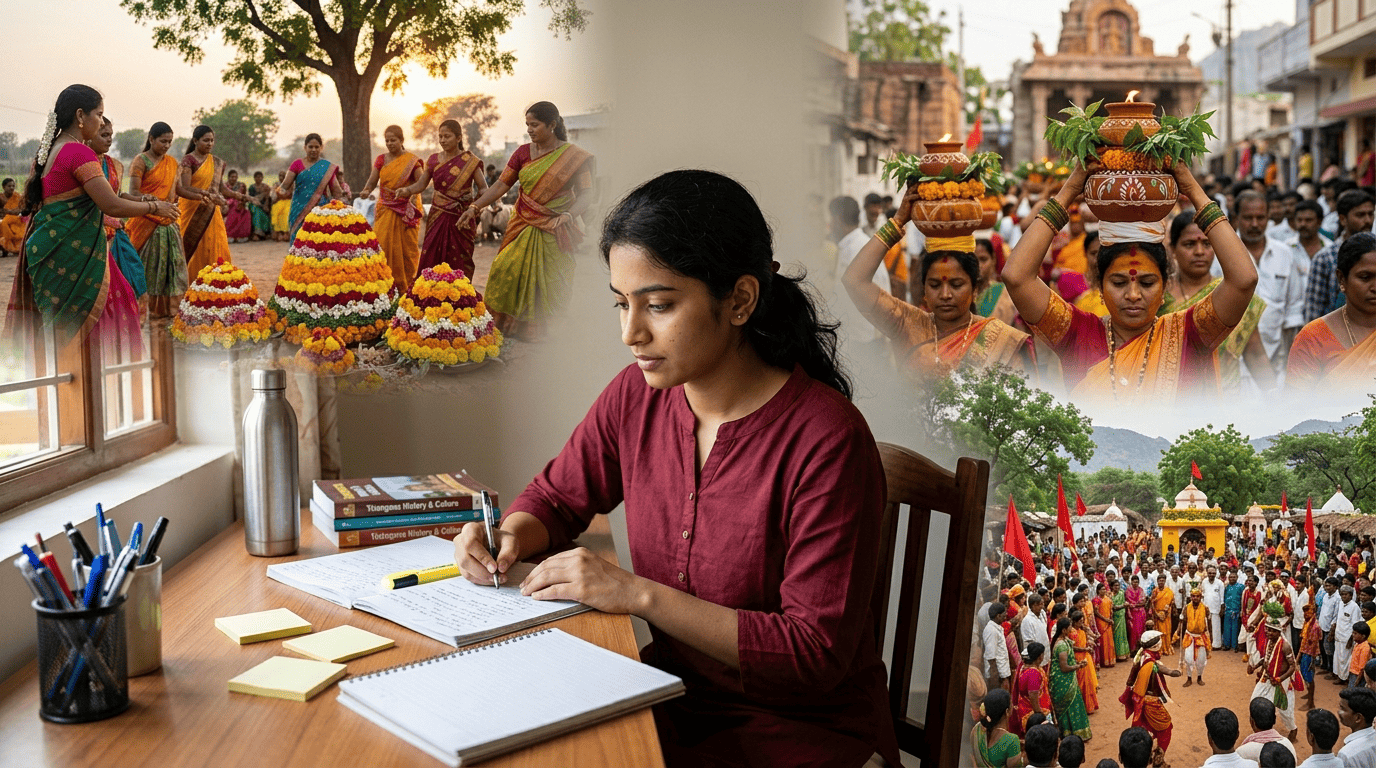
Why Telangana Festivals Matter for TSPSC Aspirants
If you are preparing for TSPSC Group 1, Group 2, Group 3, or any Telangana state government exam, festivals are not just cultural facts to memorize. They are part of Telangana society, culture, heritage, women’s traditions, folk practices, tribal identity, regional history, and state formation consciousness. In TSPSC exams, questions from Telangana culture can be direct, but the same topic can also appear in broader questions on society, identity, tourism, folk traditions, and cultural policy.
Many aspirants make a simple mistake. They remember only one line: “Bathukamma is the floral festival of Telangana” or “Bonalu is dedicated to Mahankali.” These are useful facts, but they are not enough. A serious aspirant should understand the season, rituals, communities involved, symbolism, historical background, and modern importance of each festival.
Telangana’s festivals are powerful because they reflect how people relate to nature, village deities, agriculture, seasons, community identity, and collective memory. They also show the role of women, folk artists, tribal communities, and urban neighbourhoods in preserving culture. For exam preparation, this topic is easy to score if you prepare it systematically.
How to Study Telangana Festivals for Exams
Before going festival by festival, use a smart framework. For every festival, prepare five points: when it is celebrated, where it is famous, which deity or tradition it is linked to, key rituals, and exam significance. This method will help you answer both MCQs and descriptive questions.
Use This Simple Preparation Format
- Name of the festival: Bathukamma, Bonalu, Sammakka-Saralamma Jatara, etc.
- Season or month: When it is generally celebrated.
- Region: Telangana-wide or specific district/area.
- Main theme: Nature worship, goddess worship, tribal tradition, cattle celebration, communal harmony, agriculture, or folk culture.
- Exam angle: Women’s participation, state festival, folk traditions, tourism, tribal identity, or cultural heritage.
Once you follow this method, festivals become easy to revise. Now let us understand the important festivals of Telangana in an exam-focused way.
Bathukamma: The Floral Festival of Telangana
Bathukamma is one of the most iconic festivals of Telangana and is often described as the floral festival of the state. The word Bathukamma is commonly understood as “Mother Goddess, come alive” or “Goddess of life.” It is celebrated mainly by women and represents Telangana’s deep relationship with flowers, water bodies, seasonal cycles, and feminine cultural expression.
Bathukamma is celebrated during the latter half of the monsoon season, generally around the time of Dasara/Navaratri. Women arrange seasonal flowers in a beautiful cone-shaped stack and gather in groups to sing folk songs, clap rhythmically, and move around the Bathukamma. At the end of the festival, Bathukamma is immersed in a local water body.
Why Bathukamma Is Culturally Important
Bathukamma is not just a festival of decoration. It is a celebration of nature. The flowers used are seasonal and locally available, such as gunuka, tangedu, banti, chamanti, and other wild or cultivated flowers. These flowers represent the ecological richness of Telangana and the connection between people and local biodiversity.
For TSPSC aspirants, Bathukamma is especially important because it reflects women-centered cultural participation. Unlike many public festivals dominated by male-led rituals, Bathukamma places women at the centre of celebration. It is a social space where women sing, gather, share emotions, remember family bonds, and express cultural identity.
Exam Points on Bathukamma
- Bathukamma is widely known as the floral festival of Telangana.
- It is strongly associated with women’s participation and folk songs.
- It is celebrated during the Dasara/Navaratri period.
- It uses seasonal flowers that reflect Telangana’s ecological diversity.
- It became an important symbol of Telangana cultural identity during the statehood movement.
In mains answers, you can mention Bathukamma as an example of living cultural heritage, where ecology, gender, folk tradition, and regional identity come together.
Bonalu: The Festival of Mahankali Worship
Bonalu is another major festival of Telangana, especially famous in Hyderabad, Secunderabad, and several other parts of the state. It is dedicated to Goddess Mahankali and is celebrated with devotion, processions, music, folk performance, and community participation.
The word Bonalu comes from “Bhojanalu,” meaning food or offering. During the festival, women carry decorated pots containing cooked rice, jaggery, curd, and other offerings to the goddess. The pot is usually decorated with turmeric, vermilion, neem leaves, and a lamp. Women carry these pots on their heads and offer them at temples dedicated to Mahankali.
Key Rituals of Bonalu
Bonalu is visually powerful and deeply rooted in local goddess worship. Important features include Pothuraju, who is considered the brother of the goddess and leads processions with energetic dance movements. Another important ritual element is Rangam, where an oracle-like prediction is given by a woman believed to be possessed by the goddess.
Bonalu is celebrated mainly during the month of Ashadam. In Hyderabad, famous Bonalu celebrations take place at temples such as Golconda, Secunderabad Ujjaini Mahankali temple, and Lal Darwaza. These celebrations are also important from a cultural tourism perspective.
Exam Points on Bonalu
- Bonalu is dedicated to Goddess Mahankali.
- It is celebrated prominently in Hyderabad and Secunderabad.
- Women offer decorated pots containing food to the goddess.
- Pothuraju and Rangam are important ritual elements.
- It is associated with local goddess worship and community protection.
For TSPSC mains, Bonalu can be used as an example of urban folk culture, because it is deeply rooted in local traditions while also being celebrated in major city spaces like Hyderabad.
Sammakka-Saralamma Jatara: Telangana’s Great Tribal Festival
The Sammakka-Saralamma Jatara, also known as Medaram Jatara, is one of the largest tribal festivals in India. It is held at Medaram in Mulugu district and is associated with the tribal deities Sammakka and Saralamma. This jatara is extremely important for TSPSC aspirants because it connects Telangana culture with tribal resistance, folk memory, women leaders, forest communities, and mass pilgrimage.
The festival is generally held once every two years. Devotees gather in huge numbers and offer jaggery, locally called bangaram, to the deities. Unlike many temple festivals, Medaram Jatara has a strong forest and tribal character. It does not revolve around grand stone temple architecture but around sacred memory, forest space, and community belief.
Historical and Cultural Significance
The story of Sammakka and Saralamma is linked with resistance against oppressive authority and the defence of tribal dignity. For exam purposes, you should remember that the jatara represents not only devotion but also the memory of tribal courage and sacrifice.
Medaram Jatara is a strong example of how Telangana’s cultural heritage includes both mainstream and tribal traditions. It also shows how oral traditions and local legends preserve history in communities that may not have written records.
Exam Points on Sammakka-Saralamma Jatara
- It is held at Medaram in Mulugu district.
- It is one of India’s largest tribal festivals.
- It is associated with tribal deities Sammakka and Saralamma.
- Devotees offer jaggery, known locally as bangaram.
- It reflects tribal identity, resistance, devotion, and forest-based culture.
In mains answers, use Medaram Jatara as an example of tribal cultural heritage and people’s memory of resistance.
Peerla Panduga: A Symbol of Shared Cultural Traditions
Peerla Panduga is an important festival observed in several parts of Telangana and is linked with Muharram traditions. It is known for its syncretic cultural character, where people from different communities participate in local processions and rituals. In Telangana’s cultural history, Peerla Panduga reflects communal harmony, shared spaces, and folk-level religious interaction.
In many villages and towns, Peerla processions are part of local tradition. The festival is not only a religious observance but also a social event where communities come together. Such festivals are important for TSPSC because they show the composite culture of Telangana, shaped by Hindu, Muslim, folk, rural, and Deccan traditions.
Exam Points on Peerla Panduga
- It is associated with Muharram traditions.
- It reflects Telangana’s syncretic and composite culture.
- It is observed in several villages and towns.
- It shows inter-community participation and shared cultural practices.
- It is useful for questions on communal harmony and Deccan culture.
For descriptive answers, Peerla Panduga can be mentioned when discussing Telangana as a region of cultural synthesis and shared traditions.
Sadar Festival: Celebration of Cattle and Yadav Community Culture
Sadar festival is another important cultural celebration, especially associated with the Yadav community in parts of Telangana, including Hyderabad. It is celebrated after Deepavali and involves the decoration and parade of buffaloes, especially strong and well-maintained animals.
This festival highlights the close relationship between pastoral communities, cattle wealth, and rural-urban cultural identity. In modern Hyderabad, Sadar has also become a visible community celebration where decorated buffaloes are displayed with pride.
Exam Points on Sadar
- It is associated with the Yadav community.
- It is celebrated after Deepavali.
- Decorated buffaloes are central to the celebration.
- It reflects pastoral traditions and cattle culture.
- It is an example of community-based cultural identity in Telangana.
Sadar is useful for questions related to folk culture, community festivals, and the social diversity of Telangana.
Nagoba Jatara: A Major Tribal Festival of Adilabad Region
Nagoba Jatara is an important tribal festival celebrated by the Mesram clan of the Gond tribe at Keslapur in the Adilabad region. It is dedicated to Nagoba, the serpent deity. This jatara is significant because it reflects the religious traditions, clan identity, and social organization of the Gond tribal community.
The festival includes rituals, community gatherings, and clan-based participation. It is also an occasion where tribal communities strengthen social bonds and cultural continuity. For TSPSC aspirants, Nagoba Jatara is important under tribal culture and Telangana heritage.
Exam Points on Nagoba Jatara
- It is associated with the Gond tribe, especially the Mesram clan.
- It is held at Keslapur in the Adilabad region.
- It is dedicated to Nagoba, a serpent deity.
- It reflects tribal worship, clan identity, and cultural continuity.
- It is important for Telangana tribal culture questions.
Komuravelli Mallanna Jatara
Komuravelli Mallanna Jatara is celebrated at Komuravelli in Siddipet district and is dedicated to Lord Mallanna, a form associated with Shiva. The temple and jatara attract devotees from Telangana and neighbouring regions. The festival is important because it reflects rural devotion, folk worship, and regional pilgrimage culture.
Many devotees visit the shrine during the jatara season and participate in rituals linked with vows and offerings. For TSPSC, this festival can be placed under folk religion and regional pilgrimage traditions of Telangana.
Exam Points on Komuravelli Mallanna Jatara
- It is celebrated at Komuravelli in Siddipet district.
- It is dedicated to Mallanna.
- It reflects folk Shaivite traditions and rural pilgrimage.
- It attracts devotees from Telangana and nearby areas.
Edupayala Jatara
Edupayala Jatara is celebrated at Edupayala in the Medak region and is associated with Goddess Durga Bhavani. The name Edupayala is commonly linked with the meeting or flow of seven streams. This festival combines goddess worship, riverine sacred geography, and local pilgrimage.
For exams, Edupayala is important because it connects religious devotion with Telangana’s local geography and sacred landscape. When you study such festivals, always note the location because TSPSC may ask place-based questions.
Exam Points on Edupayala Jatara
- It is associated with Goddess Durga Bhavani.
- It is celebrated in the Medak region.
- It is linked with local sacred geography and water streams.
- It is an important regional jatara of Telangana.
Other Important Festivals of Telangana
Apart from the major festivals discussed above, Telangana also celebrates many other festivals with regional and community variations. These include Ugadi, Dasara, Deepavali, Sankranti, Sri Rama Navami, Hanuman Jayanti, Ramzan, Bakrid, Christmas, and local village jatras. While some of these are celebrated across India, their local forms in Telangana have distinct food traditions, folk practices, temple rituals, and community participation.
For example, village jatras dedicated to local deities are common in Telangana. These jatras often include processions, folk songs, traditional music, fairs, local markets, and community feasts. They are important because they preserve local identity and support rural cultural economy.
Festivals and Telangana Identity
Festivals played an important role in strengthening Telangana identity, especially during the statehood movement. Bathukamma, in particular, became a strong cultural symbol of Telangana’s uniqueness. Cultural festivals helped people express regional pride and distinguish Telangana’s traditions from broader Telugu cultural narratives.
This point is very useful for TSPSC mains. You can write that Telangana’s festivals are not only religious celebrations but also instruments of cultural assertion, social unity, ecological awareness, women’s participation, and regional identity.
How Festivals Support Tourism and Local Economy
Important festivals also support tourism, small businesses, artisans, transport workers, flower sellers, potters, folk performers, food vendors, and local markets. During Bathukamma, demand for flowers increases. During Bonalu, artisans, decorators, musicians, and temple-related vendors benefit. During large jatras like Medaram, temporary markets and transport services become active on a large scale.
For exam answers on economy or culture, this is a strong value-addition point. Festivals are not only cultural events; they also create seasonal economic activity and strengthen the local informal economy.
Prelims Revision Table for Telangana Festivals
- Bathukamma: Floral festival, women’s participation, Dasara/Navaratri period, Telangana identity.
- Bonalu: Mahankali worship, Ashadam month, Pothuraju, Rangam, Hyderabad and Secunderabad.
- Sammakka-Saralamma Jatara: Medaram, Mulugu district, tribal festival, jaggery offering, tribal resistance memory.
- Peerla Panduga: Muharram-linked tradition, shared culture, communal harmony.
- Sadar: Yadav community, decorated buffaloes, after Deepavali, cattle culture.
- Nagoba Jatara: Gond tribe, Mesram clan, Keslapur, serpent deity.
- Komuravelli Mallanna Jatara: Siddipet district, Mallanna worship, rural pilgrimage.
- Edupayala Jatara: Medak region, Durga Bhavani, sacred water geography.
Common Mistakes Aspirants Should Avoid
- Studying only Bathukamma and Bonalu: TSPSC may ask about tribal jatras and community festivals too.
- Ignoring locations: Many festival questions are place-based, so revise districts and regions.
- Forgetting ritual terms: Terms like Pothuraju, Rangam, bangaram, and sangham-like community practices can be important.
- Not connecting festivals with society: In mains, festivals should be linked with gender, ecology, tribal identity, tourism, and local economy.
- Memorizing without categorising: Classify festivals as floral, goddess worship, tribal, cattle, syncretic, or pilgrimage festivals.
Final Mentor Advice: Make Culture a Scoring Area
Telangana culture is one of the most interesting and scoring areas in TSPSC preparation. Festivals like Bathukamma and Bonalu are not isolated celebrations. They represent the emotional, ecological, social, and historical life of Telangana. Tribal jatras like Sammakka-Saralamma and Nagoba show the strength of indigenous traditions. Peerla Panduga reflects shared culture. Sadar shows pastoral community identity. Together, they make Telangana’s cultural landscape rich and exam-relevant.
Your task as an aspirant is simple: prepare a one-page festival chart, revise it weekly, mark important places on a Telangana map, and practise MCQs. For mains, prepare two short notes: one on Bathukamma as a symbol of Telangana identity and another on festivals as living heritage.
When you understand festivals as society in action, Telangana culture becomes easy to remember and powerful to write about. Do not study this topic only for marks. Study it to understand the people, emotions, and traditions that shaped Telangana’s identity.