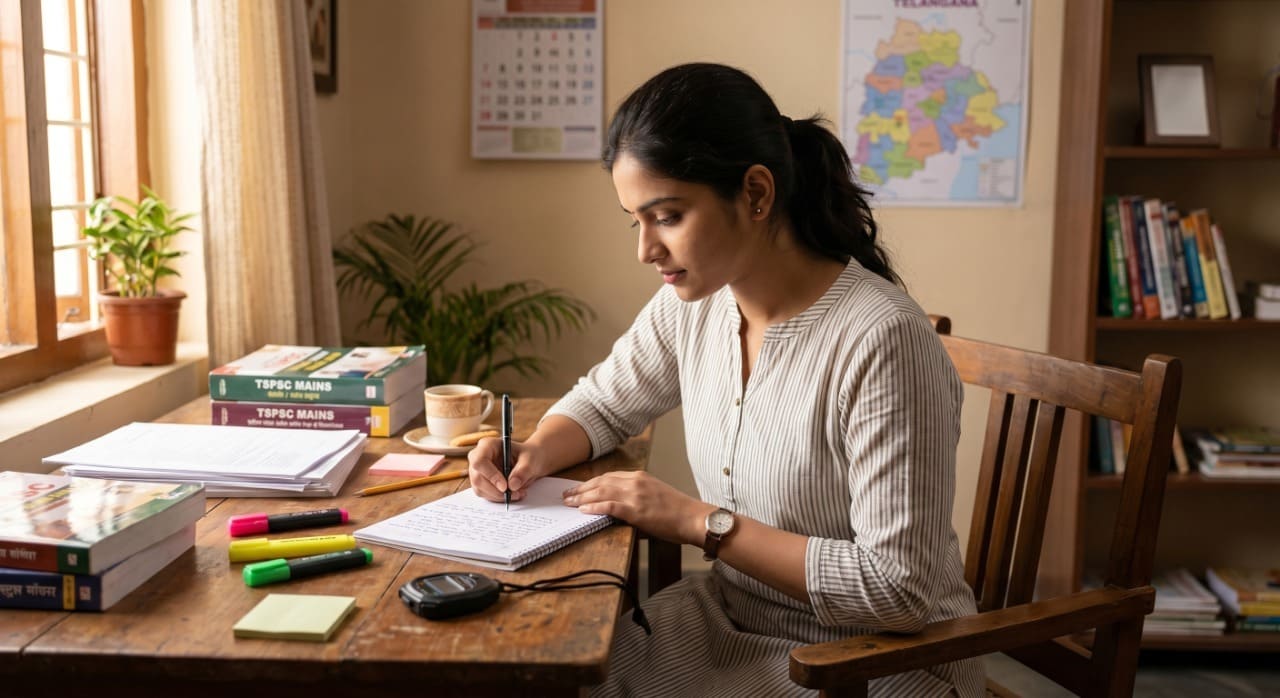
Why Answer Writing Decides Your TSPSC Group 1 Mains Rank
For many TSPSC Group 1 aspirants, the biggest shift after Prelims is this: in Prelims, you recognize the right answer; in Mains, you must create the right answer. That is a completely different skill. You may know the topic, you may have read standard books, you may have revised current affairs, but if you cannot present your thoughts clearly within limited time, your marks will not reflect your knowledge.
The TSPSC Group 1 Mains examination is descriptive in nature. It generally includes six compulsory papers, each carrying 150 marks, along with a qualifying General English paper. The main written examination is the stage where your depth, clarity, analytical ability, Telangana understanding, and writing discipline are tested seriously. The official Group I scheme and syllabus mention papers such as General Essay, History, Culture and Geography, Indian Society, Constitution and Governance, Economy and Development, Science and Technology and Data Interpretation, and Telangana Movement and State Formation.
This means one thing clearly: answer writing is not an optional skill; it is the core skill of Group 1 Mains. If you want to move from average marks to competitive marks, you must learn how to write answers that are structured, relevant, balanced, and examiner-friendly.
First Understand What the Examiner Wants
A common mistake aspirants make is writing everything they know about a topic. That is not answer writing. That is information dumping. The examiner is not looking for your entire notebook. The examiner is checking whether you understood the question, selected relevant points, organized them logically, and presented them within the word and time limit.
Every good answer has four qualities: relevance, structure, balance, and specificity. Relevance means you answer exactly what is asked. Structure means your answer has a clear introduction, body, and conclusion. Balance means you discuss different dimensions instead of writing one-sided opinions. Specificity means you use Telangana examples, constitutional provisions, data, schemes, committees, current affairs, and practical points wherever needed.
Think like this: an examiner may read hundreds of answers. Your answer should be easy to read, easy to evaluate, and strong enough to stand out. Good presentation does not mean decoration. It means clarity.
The Golden Rule: Decode the Question Before Writing
Before you write even one line, spend a few seconds understanding the demand of the question. Many aspirants lose marks because they answer the topic, not the question. For example, if the question asks, “Discuss the role of Panchayati Raj institutions in rural development in Telangana,” do not write only the history of Panchayati Raj. The demand is role, rural development, and Telangana context.
Important directive words
- Discuss: Present different aspects of the issue with explanation.
- Examine: Analyze the issue critically, including strengths and limitations.
- Explain: Make the concept clear with reasons and examples.
- Critically analyze: Write both positives and negatives, then give a balanced view.
- Evaluate: Judge the importance or effectiveness based on evidence.
- Elaborate: Expand the idea with details, examples, and dimensions.
- Comment: Give your reasoned opinion in a balanced way.
Underline the keywords mentally. Ask yourself: What is the topic? What is the directive? What is the context? What dimensions should I include? This small habit can save you from writing irrelevant answers.
Use the Introduction-Body-Conclusion Format
The safest and most effective structure for TSPSC Group 1 Mains is the Introduction-Body-Conclusion format. It works for almost every paper, from Polity and Economy to Telangana Movement and Science and Technology.
Introduction
Your introduction should be short, direct, and relevant. Do not write a long background unless the question demands it. You can begin with a definition, constitutional reference, current context, historical background, data point, or Telangana-specific line.
For example, for a question on urbanization in Telangana, you can write: “Urbanization in Telangana is shaped by the rapid growth of Hyderabad, expansion of service-sector employment, migration, and increasing pressure on urban infrastructure.” This is better than writing a generic definition of urbanization copied from a textbook.
Body
The body is where marks are earned. Divide it into clear subheadings or short paragraphs. Use points, examples, and dimensions. Avoid long, dense paragraphs. The examiner should immediately see your structure.
Conclusion
Your conclusion should not repeat the introduction. It should provide a balanced closing line or way forward. A good conclusion is optimistic, practical, and connected to governance. For example: “A balanced approach combining infrastructure, inclusive planning, environmental sustainability, and stronger urban local bodies is essential for managing urbanization in Telangana.”
Write Answers in Dimensions, Not Random Points
High-scoring answers usually cover multiple dimensions. This shows maturity. Instead of writing ten random points, organize your answer under relevant dimensions.
Useful dimensions for Group 1 Mains
- Constitutional dimension: Articles, rights, duties, federalism, institutions.
- Social dimension: Gender, caste, poverty, education, health, vulnerable groups.
- Economic dimension: Growth, employment, agriculture, industry, services, fiscal impact.
- Administrative dimension: Implementation, coordination, capacity, accountability.
- Telangana dimension: State schemes, districts, history, irrigation, rural-urban issues, Telangana Movement.
- Environmental dimension: Sustainability, climate change, biodiversity, pollution, water resources.
- Ethical dimension: Equity, justice, transparency, public service values.
For example, if the question is on irrigation in Telangana, do not write only project names. Cover agriculture impact, rural livelihoods, regional development, groundwater concerns, fiscal issues, environmental sustainability, and the need for efficient water management. That answer will look much stronger.
Make Every Answer Telangana-Specific Wherever Possible
This is one of the biggest scoring opportunities in TSPSC. Many aspirants write answers that look like generic UPSC answers. But TSPSC expects you to understand Telangana deeply. Whenever relevant, add Telangana examples.
Examples of Telangana-specific enrichment
- For irrigation: mention tanks, Mission Kakatiya, major irrigation projects, drought-prone regions, and agriculture impact.
- For economy: mention Hyderabad’s service sector, IT, pharma, agriculture, irrigation, welfare expenditure, and regional development.
- For society: mention rural-urban divide, tribal areas, women’s literacy, SC/ST welfare, and migration.
- For history and culture: mention Kakatiyas, Qutb Shahis, Asaf Jahis, Telangana Movement, Bathukamma, Bonalu, and regional identity.
- For governance: mention Panchayati Raj, municipal governance, district administration, welfare delivery, and digital governance.
Do not force Telangana examples into every sentence. But where the question allows, one or two state-specific points can make your answer more relevant and impressive.
Use Current Affairs as Examples, Not as Decoration
Current affairs should strengthen your answer, not distract from it. Many aspirants insert current affairs randomly just to show that they read newspapers. That does not help. Use current affairs only when it directly supports the question.
For example, if the question is on digital governance, you can mention digital public service delivery, online portals, DBT, e-governance, digital records, or technology in welfare delivery. If the question is on climate change, you can mention recent heatwaves, extreme rainfall, renewable energy, green hydrogen, and India’s climate commitments. If the question is on women empowerment, use recent schemes, data, or examples related to education, health, political participation, or safety.
Smart current affairs formula
- Issue: What is the current development?
- Static link: Which syllabus topic does it connect to?
- Answer use: Can it be used as an introduction, example, challenge, or way forward?
- One-line note: Write it in your revision notebook in exam-ready language.
Current affairs should not make your answer bulky. It should make your answer sharper.
Balance Facts with Analysis
Some aspirants write only facts. Some write only opinions. Both are incomplete. A good Group 1 Mains answer combines facts, analysis, and conclusion.
For example, if the question is about the role of agriculture in Telangana’s economy, facts may include rural dependence, crops, irrigation, and allied sectors. Analysis should discuss challenges such as market access, climate risk, input costs, water use, small farmers, and need for diversification. The conclusion should suggest productivity improvement, value addition, sustainable irrigation, farmer-producer organizations, and better market linkages.
This is how your answer moves from “I know the topic” to “I understand the issue.”
Improve Presentation Without Overdoing It
Presentation matters because the examiner must be able to read and evaluate your answer quickly. But presentation does not mean using too many colors, boxes, or unnecessary diagrams. It means neatness, spacing, headings, and logical flow.
Presentation tips
- Write a short introduction of 2–3 lines.
- Use subheadings where appropriate.
- Use bullet points for clarity.
- Underline only important keywords, not every line.
- Leave small spacing between sections.
- Use simple diagrams, flowcharts, or maps only when they add value.
- Keep handwriting readable, not necessarily beautiful.
- Avoid cutting and overwriting too much.
Remember, your paper should look disciplined. A neat answer creates a good first impression, but content must support that impression.
Use Diagrams, Flowcharts, and Maps Smartly
Diagrams can improve marks when used properly. But do not draw diagrams just for decoration. Use them when they save time or explain better than a paragraph.
Where diagrams help
- Economy: Flowchart showing causes and effects of unemployment, inflation, poverty, or industrial growth.
- Polity: Diagram showing separation of powers, federal structure, or grievance redressal mechanism.
- Geography: Telangana map for rivers, irrigation projects, regions, or resources.
- Science and Technology: Flowchart for AI applications, biotechnology, disaster management, or digital governance.
- Telangana Movement: Timeline of important phases and events.
Practice diagrams before the exam. Do not experiment for the first time in the actual paper. A rough, confusing diagram may hurt more than help.
Time Management: The Silent Rank Maker
Many aspirants know the answers but fail to complete the paper. This is heartbreaking because unanswered questions mean direct loss of marks. Time management must be practiced before the exam, not discovered inside the exam hall.
Since each Group 1 Mains paper is descriptive and time-bound, you must develop writing speed and decision-making. Do not spend too much time on your favorite question. Every question has value. A complete paper with decent answers usually scores better than an incomplete paper with two excellent answers.
Practical time rules
- Read the full question paper quickly before starting.
- Start with questions you can answer confidently.
- Do not spend too long planning one answer.
- Keep checking the clock after every major question.
- Leave a question if you are stuck and return later if time permits.
- Attempt all questions unless there is negative instruction.
- Practice full-length tests under timed conditions.
Writing practice is not only about content. It is also about speed, stamina, and control.
How to Practice Answer Writing Daily
You do not need to write ten answers every day from the beginning. Start small and build consistency. Answer writing is like physical training. If you suddenly attempt a full paper without practice, your hand, mind, and structure will struggle.
Beginner stage
- Write one answer daily in 150–200 words.
- Focus on structure, not perfection.
- Compare your answer with a model answer.
- Identify missing points.
- Rewrite the same answer after feedback.
Intermediate stage
- Write 3–4 answers daily from different papers.
- Practice introductions and conclusions separately.
- Add Telangana examples.
- Start using diagrams and flowcharts.
- Practice within time limits.
Advanced stage
- Write sectional tests every week.
- Write full-length tests regularly.
- Analyze marks paper-wise and topic-wise.
- Work on weak areas such as essay, economy, data interpretation, or Telangana Movement.
- Maintain an answer-improvement notebook.
The goal is not to write more pages. The goal is to write better answers with less confusion.
The 7-Point Checklist for Every Answer
Before finalizing your answer-writing practice, check whether your answer has these seven elements.
- Question demand: Did I answer exactly what was asked?
- Clear introduction: Did I start directly and relevantly?
- Structure: Did I use headings or logical paragraphs?
- Content: Did I include important concepts, facts, and examples?
- Telangana relevance: Did I add state-specific points wherever suitable?
- Balance: Did I include both benefits and challenges if required?
- Conclusion: Did I end with a practical and positive way forward?
If your answer satisfies most of these, it is moving in the right direction.
How to Write Better Introductions
A strong introduction creates confidence. But many aspirants waste time writing long historical background. Keep introductions short.
Types of introductions you can use
- Definition-based: Useful for concepts like federalism, inclusive growth, biodiversity, urbanization.
- Constitution-based: Useful for polity and governance answers.
- Data-based: Useful for economy, society, demography, education, and health.
- Current-affairs-based: Useful when the question is linked to recent developments.
- Telangana-context-based: Useful for state-specific topics.
For example, for a question on women empowerment in Telangana, you can begin with: “Women empowerment in Telangana requires progress in education, health, economic participation, safety, political representation, and access to welfare benefits.” This directly opens the answer and shows dimensions.
How to Write Strong Conclusions
Many aspirants end suddenly because they run out of time. But a conclusion gives closure. It tells the examiner that your answer is complete.
Good conclusion styles
- Way-forward conclusion: Suggest practical reforms.
- Balanced conclusion: Acknowledge both progress and challenges.
- Governance conclusion: Link the issue with better implementation and accountability.
- Telangana development conclusion: Link the issue with inclusive growth in the state.
- Constitutional conclusion: Link with justice, equality, liberty, dignity, or democracy.
Avoid emotional, dramatic, or slogan-like conclusions. Keep them mature and administrative.
Essay Paper: Do Not Treat It Like a Long General Studies Answer
The General Essay paper requires a different approach. An essay needs flow, depth, examples, and coherence. It should not look like bullet-point notes stretched into long paragraphs.
Before writing the essay, prepare a rough structure. Decide your introduction, major dimensions, examples, and conclusion. Use headings only if the exam style allows and if they improve readability. Your essay should show clarity of thought, balanced understanding, and language control.
Essay preparation tips
- Prepare themes such as democracy, governance, economy, technology, education, women, youth, agriculture, environment, and Telangana development.
- Collect examples, quotes, data, and case studies.
- Practice writing introductions in different styles.
- Maintain logical flow from problem to analysis to solution.
- Avoid extreme opinions.
- Use simple and powerful language.
A good essay feels like a guided conversation with the examiner. It should not feel like a random collection of facts.
Paper-Wise Answer Writing Approach
History, Culture and Geography
Use timelines, maps, cultural examples, Telangana-specific heritage, dynasties, architecture, festivals, rivers, resources, and regional geography. For history answers, chronology matters. For culture answers, examples matter. For geography answers, diagrams and maps can improve presentation.
Indian Society, Constitution and Governance
Use constitutional articles, Supreme Court judgments where relevant, social examples, government schemes, and administrative challenges. Write balanced answers that combine legal, social, and governance dimensions.
Economy and Development
Use basic concepts, Telangana data, budget points, schemes, sector-wise analysis, challenges, and way forward. Avoid writing only definitions. Economy answers must show cause-effect understanding.
Science and Technology and Data Interpretation
Explain applications, benefits, risks, and governance relevance. For data interpretation, practice calculations and presentation regularly. Do not ignore this paper because it can improve your overall score with practice.
Telangana Movement and State Formation
Use chronology, phases, leaders, organizations, cultural movements, regional disparities, water, jobs, funds, and identity issues. This paper requires emotional understanding but disciplined presentation. Do not write emotionally without structure.
Common Mistakes That Reduce Marks
- Writing generic answers without Telangana context.
- Ignoring the directive word in the question.
- Writing long introductions and weak bodies.
- Not completing the paper.
- Using too many facts without analysis.
- Writing one-sided answers in analytical questions.
- Using poor handwriting and crowded presentation.
- Not practicing full-length tests.
- Memorizing model answers without understanding.
- Ignoring revision of examples, data, and current affairs.
These mistakes are common, but they are correctable. Awareness itself is the first step toward improvement.
A 30-Day Answer Writing Improvement Plan
Days 1–7: Build structure
- Write one answer daily.
- Practice introductions and conclusions.
- Learn directive words.
- Review model answers.
Days 8–15: Add content quality
- Write two answers daily.
- Add Telangana examples.
- Use current affairs carefully.
- Prepare value-added notes for each subject.
Days 16–23: Improve speed and presentation
- Write answers within time limits.
- Use headings and bullet points.
- Practice diagrams and maps.
- Analyze weak areas.
Days 24–30: Test mode
- Attempt sectional tests.
- Write at least one full-length paper.
- Review mistakes honestly.
- Rewrite weak answers.
- Prepare a final answer-writing checklist.
If you follow this plan seriously, you will see visible improvement in clarity, speed, and confidence.
Final Mentor Advice
TSPSC Group 1 Mains answer writing is not magic. It is a skill built through repeated practice, feedback, correction, and revision. Do not wait until the syllabus is fully completed to start writing. If you wait for perfect preparation, you may never begin. Start with what you know and improve gradually.
At CrackSarkar, we always tell aspirants that Mains success depends on three things: knowledge, structure, and expression. Knowledge gives you content. Structure gives your answer shape. Expression makes your answer readable and convincing.
Write like a future officer: clear, balanced, practical, and solution-oriented. Use Telangana examples wherever relevant. Respect the question demand. Complete the paper. Revise value-added points. Practice under time limits. And most importantly, do not fear answer writing. The more you write, the more confident you become.
Your Mains answer sheet is not just a paper. It is your opportunity to show how you think, analyze, and solve problems. Prepare for it with discipline, and it can become the stage where your rank is truly made.