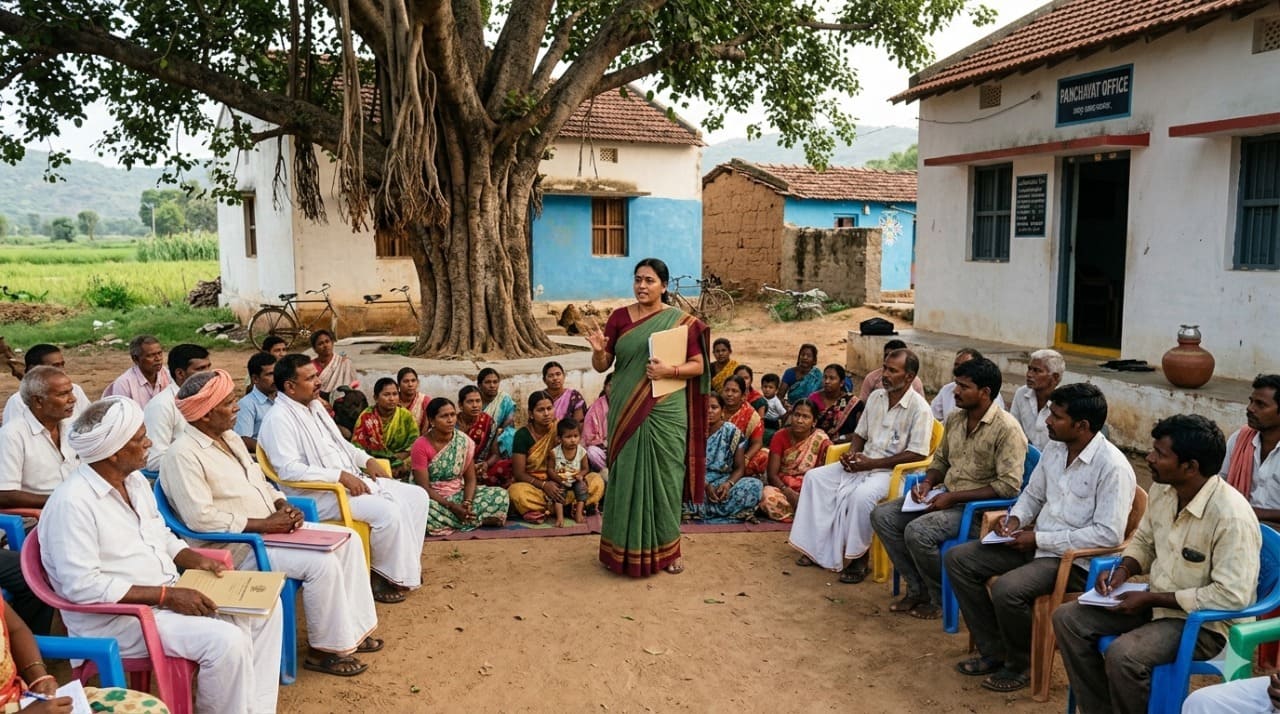
Why Panchayati Raj Matters for TSPSC Aspirants
If you are preparing for TSPSC Group 1, Group 2, Group 3, Group 4, or any Telangana state-level competitive exam, the Panchayati Raj System in Telangana is not a topic you can afford to study casually. It appears in Polity, Governance, Telangana Economy, Society, Rural Development, and even in current affairs. More importantly, it helps you understand how government actually reaches the common citizen in villages.
Many aspirants make the mistake of studying Panchayati Raj only as a constitutional topic. They memorize the 73rd Constitutional Amendment, three-tier system, Gram Sabha, and reservations, but they do not connect it with Telangana’s administration. In TSPSC exams, that connection is very important. You should know not only what Panchayati Raj is, but also how it works in Telangana, why it matters for rural development, and what challenges local bodies face.
Think of Panchayati Raj as the foundation of democracy at the village level. Parliament and State Legislature make laws, but the daily problems of rural citizens — roads, sanitation, drinking water, streetlights, drainage, local taxes, welfare delivery, village development works — are closely linked to Panchayati Raj institutions. For a future public servant, this topic is not just theory. It is practical governance.
What is Panchayati Raj?
Panchayati Raj means a system of rural local self-government. It gives people in villages the power to participate in decision-making and development planning. Instead of every decision coming from Hyderabad or district headquarters, Panchayati Raj allows local communities to identify their needs and take part in solving them.
The basic idea is simple but powerful: democracy should not stop at elections to Parliament and Assembly; it should reach the village level. A villager should have a voice in local development. A village should not only receive schemes from above; it should also discuss, plan, monitor, and question how those schemes are implemented.
In India, Panchayati Raj received constitutional status through the 73rd Constitutional Amendment Act, 1992, which came into effect in 1993. This amendment added Part IX to the Constitution and introduced provisions related to Panchayats, Gram Sabha, elections, reservations, finance, and planning.
Constitutional Background: Must-Know Points for TSPSC
For Prelims, you should remember key factual points. For Mains, you should understand the democratic purpose behind them. The 73rd Amendment is important because it gave constitutional recognition to Panchayati Raj institutions and aimed to strengthen decentralized governance.
Important constitutional features
- Part IX of the Constitution: Deals with Panchayats.
- Articles 243 to 243-O: Cover major provisions related to Panchayati Raj.
- Gram Sabha: A body consisting of registered voters in a village area.
- Three-tier system: Village, intermediate, and district levels.
- Regular elections: Panchayat elections should generally be held every five years.
- Reservations: Seats are reserved for Scheduled Castes, Scheduled Tribes, and women as per constitutional provisions.
- State Election Commission: Responsible for conducting elections to local bodies.
- State Finance Commission: Recommends financial distribution between the state and local bodies.
- Eleventh Schedule: Contains 29 subjects that may be devolved to Panchayats.
Do not study these points as dry facts. Understand their purpose. Regular elections ensure accountability. Reservations improve representation. Finance commissions support decentralization. Gram Sabha promotes direct democracy. These points become very useful in Mains answers.
Panchayati Raj System in Telangana
Telangana follows a rural local governance structure based on the Telangana Panchayat Raj Act, 2018. The Act provides for the constitution of Gram Panchayats, Mandal Praja Parishads, and Zilla Praja Parishads. For TSPSC, this Act is very important because it gives the state-specific legal framework for Panchayati Raj institutions in Telangana.
Telangana’s Panchayati Raj system broadly functions at three levels:
- Village level: Gram Panchayat
- Mandal level: Mandal Praja Parishad
- District level: Zilla Praja Parishad
This three-tier arrangement is important because rural development cannot be managed effectively by one level alone. The village level understands local needs. The mandal level coordinates development across several villages. The district level provides broader planning, supervision, and integration with district administration.
Gram Panchayat: The Village-Level Institution
The Gram Panchayat is the basic unit of Panchayati Raj administration. It is closest to the people and deals with day-to-day village-level issues. For many rural citizens, the Gram Panchayat is the most visible face of government.
The Gram Panchayat consists of elected ward members and a Sarpanch. The Sarpanch plays an important leadership role in village development, meetings, implementation of works, and coordination with officials. The Upa-Sarpanch supports the Sarpanch and may perform functions when required.
Important functions of Gram Panchayat
- Maintenance of village sanitation and cleanliness.
- Providing and maintaining streetlights.
- Maintenance of internal village roads and drains.
- Drinking water-related local works.
- Collection of certain local taxes and fees.
- Implementation of government schemes at village level.
- Maintenance of village records.
- Birth and death registration-related services where applicable.
- Promotion of public health, hygiene, and awareness.
- Coordination of welfare and development activities.
For TSPSC Mains, do not simply write that Gram Panchayat handles village development. Give examples. For instance, a Gram Panchayat can play a role in solid waste management, water conservation, Haritha Haram-type plantation activities, sanitation drives, local infrastructure, and awareness about government schemes.
Gram Sabha: The Soul of Village Democracy
If Gram Panchayat is the executive body at the village level, the Gram Sabha is the democratic foundation. It consists of all registered voters in the village. This means ordinary villagers are not just beneficiaries; they are participants in local governance.
The Gram Sabha can discuss village development plans, review implementation of works, raise local problems, question irregularities, and promote transparency. In theory, it is one of the most powerful tools of participatory democracy. In practice, its effectiveness depends on awareness, attendance, social inclusion, and genuine discussion.
Why Gram Sabha is important for exams
- It represents direct democracy at the village level.
- It improves transparency in local governance.
- It allows citizens to monitor development works.
- It helps identify genuine local needs.
- It can strengthen social audit and accountability.
In Mains answers, you can write that strengthening Gram Sabhas is essential for making Panchayati Raj more meaningful. Without active Gram Sabhas, Panchayats may become only elected bodies without deep citizen participation.
Mandal Praja Parishad: The Intermediate Level
The Mandal Praja Parishad functions at the mandal level. This level is very important in Telangana because the mandal is a key administrative unit. Many rural development activities need coordination across multiple villages, and that is where the Mandal Praja Parishad becomes relevant.
It acts as a link between Gram Panchayats and the district-level body. It helps in planning, coordination, supervision, and implementation of development programmes across the mandal. For example, issues related to schools, health centres, rural roads, agriculture extension, drinking water, and welfare schemes often require coordination beyond one village.
Role of Mandal Praja Parishad
- Coordinate development activities among Gram Panchayats.
- Support implementation of rural development schemes.
- Review progress of works at mandal level.
- Act as a bridge between village-level needs and district-level planning.
- Coordinate with mandal-level officials and line departments.
For TSPSC, remember that the mandal level is not just a middle layer. It is a practical coordination platform. Many problems are too big for one village but too local for the entire district. The mandal level fills that gap.
Zilla Praja Parishad: The District-Level Institution
The Zilla Praja Parishad functions at the district level. It is responsible for broader planning, coordination, and review of rural development activities in the district. It connects local self-government with district administration and state-level policy implementation.
The Zilla Praja Parishad has elected representatives and plays an important role in district-level rural development planning. It reviews development programmes, coordinates with Mandal Praja Parishads, and helps ensure that welfare and infrastructure schemes are implemented effectively.
Role of Zilla Praja Parishad
- Prepare and coordinate district-level rural development plans.
- Review implementation of schemes across mandals.
- Coordinate with district officials and departments.
- Support balanced development among mandals.
- Monitor works related to infrastructure, welfare, education, health, and rural development.
In Mains answers, you can present Zilla Praja Parishad as an institution that supports integrated district planning. It is especially relevant when writing answers on decentralized planning, district administration, and rural development in Telangana.
Telangana Panchayat Raj Act, 2018: Why It Is Important
The Telangana Panchayat Raj Act, 2018 is the key state law governing Panchayati Raj institutions in Telangana. It provides the legal framework for Gram Panchayats, Mandal Praja Parishads, and Zilla Praja Parishads. For TSPSC, this Act is important because questions may be asked directly from its basic structure, institutions, elections, powers, responsibilities, and administrative arrangements.
You do not need to memorize every section of the Act unless the exam specifically demands legal depth. But you should understand its broad purpose: to organize rural local bodies, define their roles, regulate elections and offices, and strengthen village-level governance.
How to study the Act smartly
- Focus first on the three-tier structure.
- Understand the roles of Sarpanch, Upa-Sarpanch, ward members, MPTCs, ZPTCs, Chairpersons, and Vice-Chairpersons.
- Study Gram Sabha and Gram Panchayat functions clearly.
- Understand election, tenure, reservation, and no-confidence concepts at a basic level.
- Connect the Act with Telangana rural development issues.
Financial Powers and Local Resources
Panchayati Raj institutions cannot function effectively without funds. A Gram Panchayat may have responsibilities, but if it does not have adequate financial resources, staff support, and technical capacity, development work becomes difficult.
Local bodies generally depend on a combination of own revenues, state government grants, central grants, Finance Commission grants, and scheme-based funds. Own revenue may include certain local taxes, fees, and charges. However, many Panchayats face difficulties in raising sufficient local revenue.
This is a very important point for Mains: real decentralization requires the devolution of functions, funds, and functionaries. These are often called the three Fs. If Panchayats are given responsibilities but not enough money or staff, decentralization remains incomplete.
Panchayati Raj and Rural Development in Telangana
Telangana has a large rural population, and rural governance plays a key role in the state’s development. Panchayati Raj institutions are connected with several important areas such as agriculture, irrigation, rural roads, sanitation, drinking water, education, health, welfare delivery, poverty reduction, and livelihood support.
For TSPSC, you should always connect Panchayati Raj with Telangana-specific themes. For example, village-level governance is important for implementing welfare schemes, improving rural infrastructure, supporting farmers, promoting women’s participation, maintaining sanitation, and improving public service delivery.
Examples you can use in answers
- Gram Panchayats can help identify eligible beneficiaries for welfare schemes.
- Gram Sabhas can improve transparency in selection of development works.
- Panchayats can support sanitation, waste management, and public health awareness.
- Local bodies can help monitor drinking water and streetlight maintenance.
- Panchayati Raj institutions can promote women’s leadership through reservations.
Women and Social Justice in Panchayati Raj
One of the most significant contributions of Panchayati Raj is political representation for women and marginalized communities. Reservations in local bodies have created opportunities for many first-generation leaders from rural backgrounds.
For Telangana and TSPSC, this is a powerful Mains point. Panchayati Raj is not only an administrative system; it is also a tool of social empowerment. When women, Scheduled Castes, Scheduled Tribes, Backward Classes, and weaker sections participate in local governance, democracy becomes more inclusive.
However, representation alone is not enough. Elected representatives need training, awareness, access to information, administrative support, and freedom to function independently. This is where capacity building becomes important.
Challenges in Panchayati Raj System
No system is perfect. Panchayati Raj has great potential, but it faces several challenges. TSPSC Mains may ask questions like: “Discuss the role of Panchayati Raj institutions in rural development” or “Explain the challenges faced by local self-government in Telangana.” For such answers, you need balanced points.
Major challenges
- Inadequate funds: Many Panchayats depend heavily on higher-level grants.
- Limited administrative capacity: Local representatives may need more training in budgeting, planning, and implementation.
- Weak Gram Sabha participation: Low attendance reduces accountability.
- Political interference: Local governance may be affected by party politics or pressure groups.
- Dependence on officials: Elected bodies may not always have full control over functionaries.
- Social inequalities: Caste, gender, and class factors may influence participation.
- Transparency issues: Without proper monitoring, local works may suffer from delays or leakages.
- Digital divide: Technology-based governance may exclude people without digital access or awareness.
How to Write a Strong TSPSC Mains Answer on Panchayati Raj
A good answer should not look like a copied textbook paragraph. It should have structure, Telangana relevance, examples, and a balanced conclusion. Use the introduction-body-conclusion method.
Sample answer framework
- Introduction: Define Panchayati Raj as rural local self-government and mention constitutional status under the 73rd Amendment.
- Body part 1: Explain the three-tier system in Telangana — Gram Panchayat, Mandal Praja Parishad, and Zilla Praja Parishad.
- Body part 2: Discuss functions such as local development, sanitation, welfare delivery, planning, and citizen participation.
- Body part 3: Mention challenges such as funds, capacity, weak Gram Sabha participation, and administrative dependence.
- Way forward: Suggest capacity building, stronger Gram Sabhas, digital transparency, timely funds, social audits, and better devolution of powers.
- Conclusion: End with the idea that strong Panchayati Raj is essential for grassroots democracy and inclusive rural development in Telangana.
Use simple but powerful phrases like grassroots democracy, participatory governance, decentralized planning, inclusive development, and last-mile service delivery. These phrases improve answer quality when used naturally.
Prelims Preparation: What to Remember
For Prelims, focus on clear facts. Do not overcomplicate the topic. Prepare short notes and revise them regularly.
Important Prelims areas
- 73rd Constitutional Amendment Act.
- Part IX of the Constitution.
- Articles 243 to 243-O.
- Eleventh Schedule and 29 subjects.
- Gram Sabha meaning and role.
- Three-tier Panchayati Raj structure.
- State Election Commission and State Finance Commission.
- Telangana Panchayat Raj Act, 2018.
- Gram Panchayat, Mandal Praja Parishad, and Zilla Praja Parishad.
- Roles of Sarpanch, Upa-Sarpanch, MPTC, ZPTC, Chairperson, and Vice-Chairperson.
Current Affairs Link: Why You Should Follow Panchayat News
Panchayati Raj is also a current affairs topic. Local body elections, reservation policy, Finance Commission grants, village development programmes, sanitation initiatives, digital Panchayat services, and rural infrastructure schemes can all become relevant for TSPSC.
Whenever you read news related to Panchayats in Telangana, do not just save the article. Connect it with concepts. Ask yourself: Is this about representation? Is it about finances? Is it about elections? Is it about rural development? Is it about state control versus local autonomy? This method helps you convert current affairs into exam-ready understanding.
Final Mentor Advice
Do not study Panchayati Raj as a boring administrative chapter. Study it as the place where democracy meets daily life. A road repaired in a village, a drinking water issue raised in a Gram Sabha, a woman Sarpanch leading sanitation work, a local body monitoring welfare delivery — these are not small things. They are examples of democracy working at the grassroots.
For TSPSC, your goal should be threefold: understand the constitutional foundation, master Telangana’s three-tier structure, and connect the topic with rural development challenges. If you do this, Panchayati Raj becomes one of the most scoring and useful topics in your preparation.
At CrackSarkar, we always tell aspirants that strong preparation is not about memorizing isolated facts. It is about understanding how governance works in real life. Panchayati Raj is one of the best topics to build that understanding. Study it with clarity, revise it with discipline, and use it confidently in Prelims, Mains, and interviews.