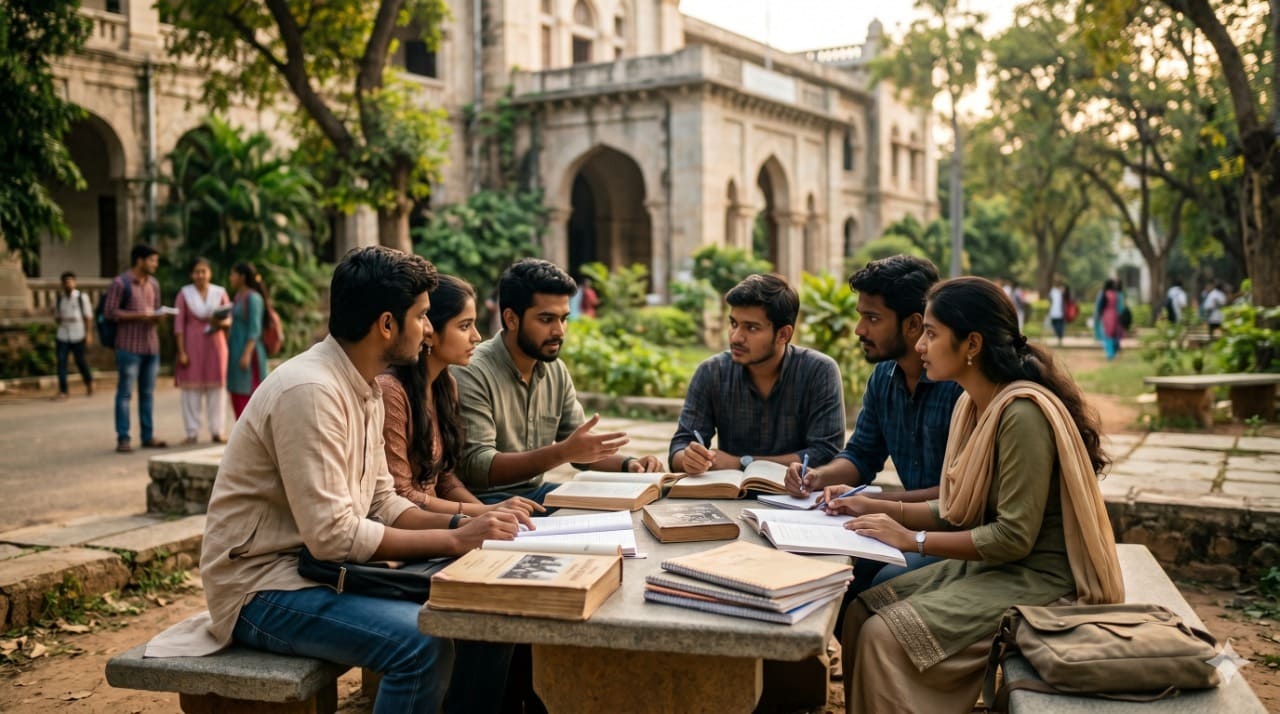
The Telangana Movement was not only a political movement led by parties and leaders. It was also a people’s movement powered by students, teachers, employees, writers, artists, intellectuals, farmers, workers, and ordinary citizens. Among all these groups, students and universities played a historic role. They gave energy, emotion, courage, slogans, street power, intellectual clarity, and moral force to the demand for Telangana statehood.
For TSPSC aspirants, this topic is extremely important. Questions from the Telangana Movement are often framed around dates, organizations, universities, student participation, agitations, committees, and the role of different social groups. But if you study this topic only as a list of events, you will miss the real story. The role of students must be understood as a combination of youth aspiration, regional injustice, employment concerns, cultural identity, and democratic protest.
In this blog, let us take a deep and practical look at how students and universities shaped the Telangana Movement and why this topic is high-value for TSPSC preparation.
Why Students Became Central to the Telangana Movement
Students became central to the Telangana Movement because the issues of Telangana were directly connected with their future. When people spoke about jobs, education, local opportunities, regional discrimination, resource distribution, and self-respect, students naturally felt involved. For a young aspirant, these were not abstract political issues. They affected admissions, government employment, scholarships, hostel facilities, local identity, and dignity.
The Telangana Movement repeatedly raised questions such as:
- Were Telangana students getting fair educational opportunities?
- Were local youth receiving fair access to government jobs?
- Were promises made during merger being implemented properly?
- Were Telangana’s resources being used for Telangana’s development?
- Was Telangana culture receiving proper recognition?
These questions created strong student participation. Students did not see the movement only as a political demand. Many saw it as a struggle for justice, representation, and future security.
Universities as Centres of Political Awareness
Universities are not just places where students attend classes and write exams. In social movements, universities often become centres of debate, awareness, organization, and protest. Telangana was no exception. Campuses became spaces where students discussed history, read about regional inequalities, questioned policies, formed unions, organized meetings, and participated in rallies.
Universities helped the movement in three major ways:
- Intellectual role: Students and teachers analyzed Telangana’s historical, economic, cultural, and political issues.
- Organizational role: Campuses became meeting points for mobilization, protests, and student unions.
- Emotional role: Universities gave the movement youthful energy, sacrifice, and mass appeal.
For TSPSC, remember this clearly: universities gave both ideas and action to the Telangana Movement.
Osmania University: The Heart of Student Mobilization
No discussion on students and the Telangana Movement is complete without mentioning Osmania University. Located in Hyderabad, Osmania University has historically been one of the most important centres of education, culture, political debate, and student activism in Telangana.
During different phases of the Telangana Movement, Osmania University became a major platform for student protests and ideological discussions. Its campus witnessed meetings, rallies, cultural programs, hunger strikes, police confrontations, and emotional appeals for statehood. For many Telangana supporters, Osmania University was not just an institution; it became a symbol of Telangana youth resistance.
Why was Osmania University so important?
- It had a large student population from different parts of Telangana.
- It had a strong history of political consciousness.
- It was located in Hyderabad, the political and administrative centre.
- It attracted students from rural and semi-urban Telangana backgrounds.
- It became a visible symbol for media, political leaders, and civil society.
In TSPSC answers, you can write that Osmania University acted as the nerve centre of student activism during major phases of the Telangana Movement.
Student Role in the 1969 Telangana Agitation
The 1969 Telangana agitation was one of the most significant phases in the history of the movement. It emerged after growing dissatisfaction over the alleged violation of safeguards given to Telangana at the time of Andhra Pradesh’s formation. Students played a major role in turning this dissatisfaction into mass protest.
The issues that attracted students included employment safeguards, Mulki rules, educational opportunities, and the feeling that Telangana’s interests were not being protected. Universities and colleges became active centres of protest. Student demonstrations, strikes, meetings, and rallies gave intensity to the movement.
The 1969 agitation showed that students were not passive observers. They became direct participants. Their involvement made the movement emotional, visible, and powerful. The sacrifices of students during this phase became part of Telangana’s political memory and continued to inspire later generations.
Exam-Relevant Points from the 1969 Phase
- Students played a major role in mobilizing public opinion.
- University campuses became centres of protest.
- The agitation was linked with safeguards, jobs, education, and regional justice.
- Student participation gave the movement moral and emotional strength.
- The memory of 1969 influenced later Telangana agitations.
Employment Concerns and Youth Anger
One of the strongest reasons for student participation was the issue of government jobs. For many young people in Telangana, education was seen as a path to employment and social mobility. When there was a perception that local job opportunities were not being protected, students felt directly affected.
The issue was not only about jobs. It was about fairness. Students asked: if Telangana had merged with safeguards, why were local youth still worried about losing opportunities? This anger was especially strong among students preparing for government jobs and those coming from rural Telangana families.
For TSPSC, this point is extremely important because it connects Telangana history with your own exam context. The demand for fair employment, local opportunities, and administrative justice is one of the recurring themes of the Telangana Movement.
Role of Student Organizations and Joint Action Committees
Student organizations played an important role in mobilizing youth during different phases of the movement. They organized campus meetings, rallies, protest programs, awareness campaigns, cultural events, and discussions. During the later phase of the movement, student groups also became part of wider Joint Action Committee-style mobilization, where different sections of society came together for the Telangana cause.
The strength of student organizations was their ability to move quickly and communicate emotionally. Students could reach hostels, classrooms, libraries, villages, and town centres. Their slogans and songs spread fast. Their participation often pushed political parties and public representatives to respond more seriously to the demand.
How Student Organizations Helped the Movement
- They mobilized students across campuses.
- They organized protests, rallies, and meetings.
- They spread awareness about Telangana’s historical grievances.
- They connected student issues with larger regional issues.
- They created pressure on political leadership.
- They helped convert emotional support into organized action.
Teachers, Professors, and Intellectual Support
Students were not alone. Teachers, professors, researchers, writers, and intellectuals also played an important role. Universities became spaces where Telangana’s history, economy, irrigation issues, employment concerns, cultural identity, and political demands were studied and explained.
Professors and intellectuals helped the movement by providing facts, arguments, data, speeches, books, articles, and public lectures. This gave the movement intellectual strength. A movement becomes stronger when emotion is supported by evidence, and universities helped provide that evidence.
For TSPSC mains, this is a strong point: the Telangana Movement combined mass mobilization with intellectual justification. Students gave energy; intellectuals gave arguments; society gave support.
Cultural Mobilization on Campuses
The Telangana Movement was not only fought through speeches and protests. It was also expressed through songs, poetry, street plays, folk performances, slogans, and cultural programs. University campuses became important spaces for this cultural expression.
Telangana songs and cultural performances carried messages of self-respect, injustice, sacrifice, and hope. These cultural forms were powerful because they reached people emotionally. A speech may convince the mind, but a song can move the heart.
Students used cultural mobilization to:
- Spread awareness in simple language
- Strengthen Telangana identity
- Remember martyrs and sacrifices
- Encourage participation in protests
- Build unity across districts and communities
For exams, connect this with Telangana’s broader cultural revival during the movement. Language, dialect, folk arts, festivals, and local symbols became important parts of political assertion.
Universities Beyond Osmania
Although Osmania University is the most prominent example, student participation was not limited to one campus. Students from many universities, colleges, degree institutions, professional colleges, and rural educational centres participated in different forms. Campuses across Telangana contributed to awareness-building, rallies, discussions, and local mobilization.
Institutions in districts also played a role because Telangana was not only a Hyderabad-based movement. Students from rural backgrounds carried the message back to their villages and towns. In this way, universities and colleges became links between urban political debate and rural public sentiment.
This is an important analytical point for TSPSC: student movements helped connect campus politics with mass politics.
The Later Phase: Students in the Statehood Movement
In the later phase of the Telangana Movement, especially after the formation of Telangana Rashtra Samithi and during the intensified statehood struggle, students again became highly visible. Osmania University and other campuses saw strong student participation in rallies, protests, hunger strikes, and public meetings.
Students raised slogans, organized campus-level actions, participated in wider social mobilization, and became a strong emotional force behind the demand for separate Telangana. Their role attracted media attention and created pressure on political leadership. Student participation also helped keep the movement alive during critical moments.
In this phase, the movement was no longer limited to one section. It included employees, lawyers, teachers, artists, women, farmers, political groups, civil society organizations, and students. But students remained one of the most visible and emotionally powerful sections.
Why Student Sacrifice Became a Powerful Symbol
Every movement has symbols that keep it alive. In Telangana, student sacrifice became one such powerful symbol. The idea that young people were willing to risk their education, careers, and even lives for Telangana created deep emotional impact.
This sacrifice made society take the movement more seriously. Parents, teachers, employees, writers, and political leaders could not ignore the intensity of student feeling. Student participation reminded everyone that Telangana was not only about the past; it was about the future of the next generation.
For TSPSC answers, you can write that student sacrifice gave the movement moral legitimacy and emotional urgency.
Role of Hostels, Libraries, and Campus Spaces
When studying student movements, do not think only about public rallies. Much of the movement’s energy was built in everyday campus spaces: hostels, libraries, tea stalls, classrooms, seminar halls, student union rooms, and university grounds.
These spaces allowed students to discuss, debate, plan, and organize. A hostel room could become a discussion centre. A library could become a place where students read about Telangana history. A campus ground could become a protest site. A classroom discussion could turn into political awareness.
This is how movements grow. They do not begin only with big public meetings. They begin with conversations, questions, and shared frustration.
Women Students and Participation
Women students also participated in the Telangana Movement through rallies, meetings, cultural programs, awareness campaigns, and public demonstrations. Their participation is important because it widened the social base of the movement. It showed that the Telangana demand was not limited to male-dominated political spaces.
Women students brought courage, discipline, and moral strength to campus mobilization. For TSPSC mains, mentioning women’s participation gives your answer better depth and inclusiveness.
Media Visibility and Student Protests
Student protests often received strong media attention because universities are symbolic spaces. When students protest, society notices. When a major university campus becomes active, the issue gains visibility beyond local boundaries.
Media coverage of student protests helped bring Telangana issues into public discussion. It amplified slogans, demands, emotional appeals, and incidents from campuses. This visibility increased pressure on governments and political parties.
However, aspirants should write this point carefully. Media did not create the movement, but it helped spread its visibility. The real force came from people’s participation and long-standing grievances.
How to Write This Topic in TSPSC Mains
If a question asks, “Discuss the role of students and universities in the Telangana Movement,” your answer should be structured, not emotional. Use this framework:
Model Answer Structure
- Introduction: Mention that students and universities played a crucial role in giving energy, organization, and ideological strength to the Telangana Movement.
- Historical role: Explain student participation in the 1969 agitation.
- University role: Discuss Osmania University and other campuses as centres of mobilization.
- Issues: Mention employment, education, regional safeguards, self-respect, and cultural identity.
- Methods: Rallies, strikes, debates, cultural programs, student organizations, awareness campaigns.
- Intellectual support: Role of teachers, professors, and writers.
- Significance: Students gave moral force, visibility, and continuity to the movement.
- Conclusion: Link student participation with the eventual achievement of Telangana statehood.
Most Important Points for MCQs
- Students were major participants in the 1969 Telangana agitation.
- Osmania University was a key centre of student mobilization.
- Employment safeguards and local opportunities were major student concerns.
- Universities acted as centres of debate, protest, and ideological awareness.
- Student organizations helped mobilize youth across campuses.
- Teachers and intellectuals provided arguments and historical justification.
- Cultural programs, songs, and slogans helped spread Telangana identity.
- Student sacrifice became a strong emotional symbol of the movement.
- Student participation linked campus politics with mass politics.
- The role of students continued across different phases of the movement.
Common Mistakes Aspirants Should Avoid
Many aspirants write this topic in a very general way. Avoid these mistakes:
- Mistake 1: Writing only about Osmania University and ignoring other campuses.
- Mistake 2: Writing only emotional points without linking to employment, education, and safeguards.
- Mistake 3: Forgetting the 1969 agitation.
- Mistake 4: Ignoring the role of teachers and intellectuals.
- Mistake 5: Not connecting student participation with the wider Telangana Movement.
Final Mentor Advice
Dear aspirant, the role of students in the Telangana Movement is not just a historical fact. It is a reminder that young people can shape history when they combine awareness with courage. Students turned campuses into centres of debate, protest, cultural assertion, and political pressure. Universities became more than educational institutions; they became platforms for democratic expression.
For TSPSC, study this topic with both heart and structure. Understand the emotion of the movement, but write answers with facts, phases, institutions, and significance. That is how you score well.
Your next task is simple: prepare a one-page note under four headings — 1969 Agitation, Osmania University, Student Issues, Significance. Then write a 150-word answer on the role of students in the Telangana Movement. This one exercise will make the topic exam-ready.
The Telangana Movement shows that students are not just learners of history. Sometimes, they become makers of history.