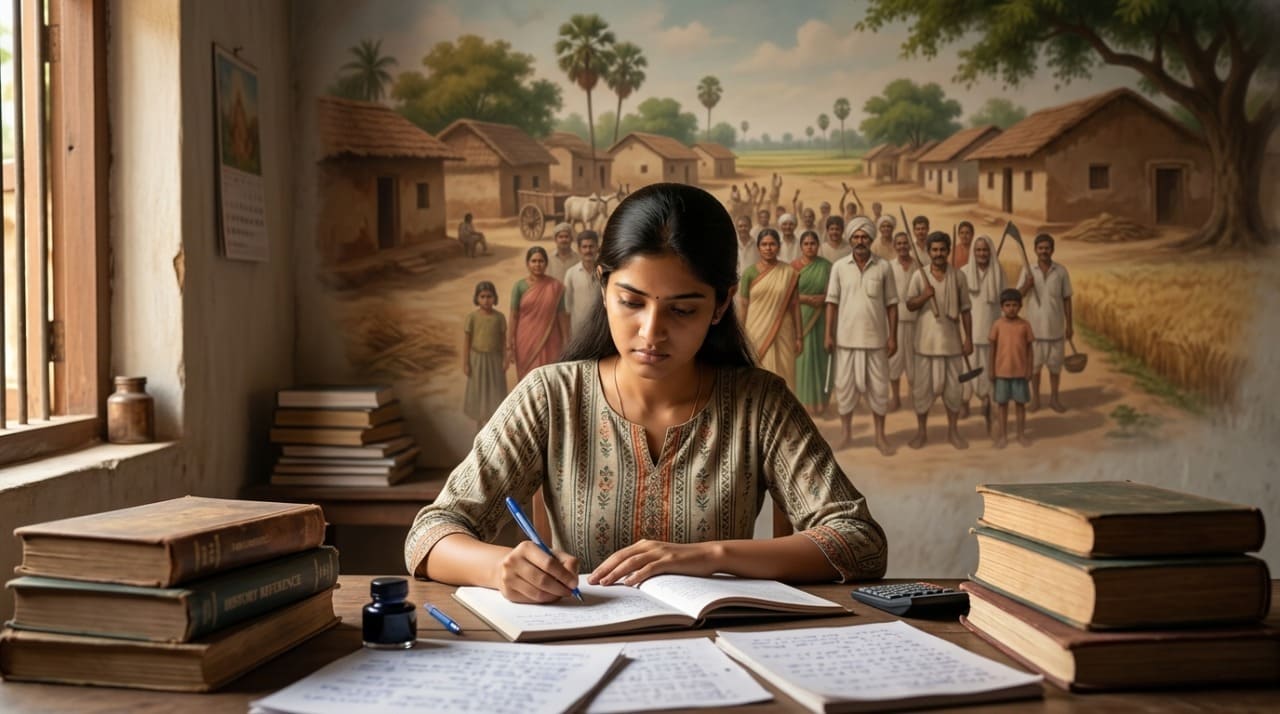
Why the Telangana Armed Struggle Matters for TSPSC Aspirants
If you are preparing for TSPSC Group 1, Group 2, Group 3, or any Telangana state government exam, the Telangana Armed Struggle of 1946–1951 is not just another history topic. It is one of the most important chapters in Telangana’s social, political, agrarian, and cultural history. Questions from this topic can appear in prelims, mains, interviews, and even essay-type discussions because it connects many themes: feudal oppression, peasant mobilization, Nizam’s rule, Razakar violence, Communist leadership, land reforms, women’s participation, and the integration of Hyderabad State into the Indian Union.
Many aspirants make one common mistake. They memorize a few names and dates but fail to understand the movement as a story. That approach may help in one or two factual MCQs, but it will not help in analytical questions. To master this topic, you must understand why the struggle started, how it expanded, what changed after 1948, and why it continued until 1951.
Think of the Telangana Armed Struggle as a powerful people’s movement that began from village-level injustice and gradually became a major political challenge to feudal authority in Hyderabad State. It was not merely a rebellion. It was a fight for dignity, land, freedom from vetti, and democratic rights.
Background: The Conditions That Created the Struggle
Before studying the milestones, you must first understand the background. Telangana was part of the princely State of Hyderabad under the Nizam. In many rural areas, the actual power was not only with the state but also with local feudal landlords, known through systems connected with jagirdars, deshmukhs, doras, and other dominant intermediaries.
For ordinary peasants, especially poor peasants, tenants, agricultural labourers, Dalits, tribal communities, and backward communities, life was extremely difficult. They faced high rents, illegal exactions, forced labour, social humiliation, bonded-like obligations, and lack of basic rights. The practice of vetti, or unpaid forced labour, became one of the most hated symbols of oppression.
At the same time, new political awareness was spreading through the Andhra Mahasabha, progressive cultural activities, village-level organization, and Communist mobilization. The movement did not appear suddenly in 1946. It was the result of years of social awakening, anti-feudal anger, and organized political work among the rural masses.
Milestone 1: Growth of Andhra Mahasabha and Political Awakening
One of the earliest foundations of the Telangana Armed Struggle was the transformation of Andhra Mahasabha from a cultural and social platform into a more active political force. Initially, it worked on issues such as language, education, social reform, and civil rights. But over time, especially under the influence of left-oriented leaders and activists, it began taking up peasant issues more directly.
For TSPSC preparation, remember this clearly: the Armed Struggle did not begin as only a military confrontation. It began as a social and agrarian mobilization. Village meetings, awareness campaigns, songs, pamphlets, and local committees helped ordinary people understand that their suffering was not individual fate but part of a larger oppressive system.
This phase is important because it explains how fear slowly reduced among villagers. When peasants began to meet collectively and question illegal levies, vetti, and landlord domination, the base for the later armed phase was created.
Milestone 2: 1946 and the Spark of Open Resistance
The year 1946 is usually treated as the starting point of the Telangana Armed Struggle. By this time, anti-feudal anger had intensified in several villages. The struggle gained momentum particularly in areas where landlords used private force and state support to suppress peasants.
One of the most remembered incidents connected with the early phase is the martyrdom of Doddi Komaraiah in 1946. His death became a turning point because it transformed local resentment into wider resistance. For exam purposes, Doddi Komaraiah is not just a name to memorize. He represents the moment when the agrarian movement entered a sharper phase and inspired more villages to join the struggle.
After this phase, the movement expanded across several parts of Telangana, especially in districts such as Nalgonda, Warangal, and Khammam. These regions became major centres of peasant mobilization because feudal exploitation was intense and organizational networks were active.
Milestone 3: Village-Level Sanghams and Peasant Organization
One of the strongest features of the Telangana Armed Struggle was the formation and spread of village-level sanghams. These sanghams gave peasants a collective voice. Instead of suffering silently, villagers began to discuss their problems, resist exploitation, and support each other.
From a TSPSC point of view, sanghams are extremely important because they show the democratic and grassroots nature of the movement. They were not just fighting units. They were also instruments of social change.
What did village sanghams focus on?
- Opposing vetti and forced labour.
- Resisting illegal taxes and arbitrary collections.
- Questioning landlord control over land and village life.
- Mobilizing peasants, labourers, and oppressed communities.
- Creating confidence among ordinary villagers.
- Supporting social reform and dignity for marginalized groups.
This is where many aspirants should improve their understanding. The movement was not only about weapons. It was about organization. Without village-level organization, the armed resistance could not have survived for several years.
Milestone 4: Expansion of the Armed Phase
As repression increased, sections of the movement moved into armed resistance. Peasant squads were formed in several areas to defend villages, resist landlord attacks, and protect activists. This phase made the struggle more intense and brought it into direct conflict with the Nizam’s administration, local feudal forces, and later the Razakars.
The armed phase should be understood in its historical context. Many villages faced violence from landlords and armed groups. In such conditions, the movement believed that self-defence was necessary. For TSPSC mains, you can write that the armed phase emerged from the combination of agrarian grievances, state repression, and the need for village defence.
In several areas, peasants challenged landlord authority and redistributed or cultivated lands under local control. This made the movement a serious threat to feudal structures. It also made the struggle socially transformative because it raised questions about who had the right to land, labour, and dignity.
Milestone 5: Role of the Communist Party and Key Leaders
The Communist Party played a major role in organizing and leading the Telangana Armed Struggle. It worked through peasant mobilization, village committees, ideological training, and armed squads. Leaders and activists helped connect local grievances with a larger political programme against feudalism and autocratic rule.
Some important names associated with the broader movement include Ravi Narayan Reddy, Baddam Yella Reddy, Puchalapalli Sundarayya, Chandra Rajeswara Rao, Mallu Swarajyam, Arutla Ramchandra Reddy, Arutla Kamaladevi, and many local-level organizers and martyrs whose contributions were crucial at the village level.
For prelims, learn names and associations. For mains, go deeper. Understand how leadership worked at different levels: ideological leadership, village mobilization, women’s participation, armed defence, and cultural propaganda. The movement survived because leadership was not limited to one person. It had a network of committed organizers.
Milestone 6: Women’s Participation in the Struggle
A serious TSPSC aspirant should never ignore the role of women in the Telangana Armed Struggle. Women participated as messengers, organizers, cultural activists, supporters of squads, protestors, and in some cases direct participants in resistance activities. The struggle also challenged social practices that limited women’s public role.
Leaders such as Mallu Swarajyam and Arutla Kamaladevi are often remembered for their role in the movement. But beyond famous names, thousands of ordinary women supported the struggle in villages by providing food, shelter, intelligence, and moral strength.
In mains answers, women’s participation can be used as a strong example to show that the movement was not merely political but also social. It created spaces where marginalized groups, including women, could challenge traditional hierarchies.
Milestone 7: Razakar Violence and Intensification of Conflict
As the political crisis in Hyderabad State deepened, the Razakars became a major force under the leadership of Kasim Razvi and the Majlis-e-Ittehadul Muslimeen. The Razakars supported the continuation of the Nizam’s rule and opposed democratic integration with India. Their violence added a new dimension to the situation in Telangana.
For villagers already facing feudal oppression, Razakar attacks intensified fear and insecurity. The armed struggle now had to confront not only landlord power but also Razakar violence and the broader crisis of Hyderabad’s future. This phase is important for understanding why the Telangana issue became linked with the larger question of Hyderabad State’s integration into the Indian Union.
Milestone 8: 1947 Independence and Hyderabad’s Refusal to Join India
India became independent on 15 August 1947, but Hyderabad State did not immediately join the Indian Union. The Nizam wanted to remain independent, creating a serious political crisis. For people in Telangana, this meant that independence had not brought immediate democratic freedom from autocratic rule.
This is a powerful point for exams. While the rest of India celebrated independence, many people in Hyderabad State continued to live under the Nizam’s rule and feudal structures. The Telangana Armed Struggle therefore became connected to both anti-feudal struggle and anti-autocratic struggle.
When writing answers, do not treat 1947 as the end of colonial rule everywhere in the same way. In princely states like Hyderabad, the process of integration and democratization had its own complexities.
Milestone 9: Police Action and Integration of Hyderabad in 1948
In September 1948, the Indian government launched military action, popularly known as Police Action, to integrate Hyderabad State into the Indian Union. The Nizam’s rule came to an end, and Hyderabad became part of India.
Many beginners assume that the Telangana Armed Struggle ended immediately after Police Action. This is incorrect. The situation changed, but the struggle did not end at once. After 1948, the political context shifted. The movement was no longer fighting the Nizam in the same way, but issues of land, repression, and Communist-led armed activity continued.
For TSPSC exams, this is one of the most important analytical points: 1948 was a turning point, not the final end of the struggle.
Milestone 10: Continuation of the Struggle After 1948
After Hyderabad’s integration, the Indian state sought to restore order and control. The Communist-led armed struggle continued in some areas, especially where land issues and peasant control had become deeply rooted. This led to confrontation between the state and the remaining armed squads.
The post-1948 phase is complex. The original anti-Nizam context had changed, but the agrarian question had not disappeared. Peasants who had experienced some form of local empowerment did not want to return to the old feudal order. The government, on the other hand, wanted to establish administrative control and end armed activity.
In mains answers, you can explain this phase as a transition from anti-Nizam armed resistance to a broader conflict over land, authority, and state power in newly integrated Hyderabad.
Milestone 11: Withdrawal of the Armed Struggle in 1951
The Telangana Armed Struggle formally came to an end in 1951 when the Communist Party decided to withdraw the armed struggle. This marked the conclusion of one of the most significant peasant movements in modern Indian history.
The withdrawal was influenced by changing political conditions, repression, strategic reassessment, and the new democratic framework emerging in independent India. The movement had already left a deep impact on Telangana society. It weakened feudal authority, raised land and labour questions, created political awareness, and inspired later struggles for social justice and regional identity.
Timeline: Quick Revision for TSPSC Aspirants
- Pre-1946: Growth of Andhra Mahasabha, social reform, civil rights awareness, and peasant mobilization.
- 1946: Beginning of the armed phase; Doddi Komaraiah’s martyrdom becomes a major turning point.
- 1946–1947: Expansion of village sanghams and resistance against vetti, illegal levies, and landlord oppression.
- 1947: India becomes independent, but Hyderabad State remains outside the Indian Union under the Nizam.
- 1947–1948: Razakar violence intensifies; conflict deepens in Telangana villages.
- September 1948: Police Action leads to the integration of Hyderabad State into India.
- 1948–1951: Armed struggle continues in changed political conditions, mainly around agrarian and state power questions.
- 1951: Communist Party withdraws the armed struggle.
How to Study This Topic for TSPSC Prelims
For prelims, focus on factual clarity. You should know the chronology, important personalities, organizations, places, and terms. But do not memorize isolated facts without context. Connect each fact with the larger story.
Prelims Preparation Checklist
- Learn the timeline from 1946 to 1951 in correct order.
- Remember the role of Andhra Mahasabha in political awakening.
- Understand the importance of Doddi Komaraiah’s martyrdom.
- Know major leaders associated with the movement.
- Revise terms like vetti, jagirdari, deshmukh, sangham, Razakars, and Police Action.
- Identify the main regions where the movement was strong, especially Nalgonda, Warangal, and Khammam.
- Practise MCQs that test chronology and cause-effect relationships.
How to Write Mains Answers on Telangana Armed Struggle
For mains, your answer should not look like a list of events. It should have structure. Start with the background, explain causes, describe phases, mention key milestones, and end with significance. Always connect the movement with Telangana’s socio-economic transformation.
A Simple Mains Answer Framework
- Introduction: Define the Telangana Armed Struggle as a major peasant and anti-feudal movement from 1946 to 1951.
- Background: Mention Nizam’s rule, feudal exploitation, vetti, and rural oppression.
- Causes: Agrarian injustice, forced labour, illegal levies, lack of rights, and political awakening.
- Milestones: Andhra Mahasabha, 1946 uprising, Doddi Komaraiah, village sanghams, Razakars, Police Action, continuation after 1948, withdrawal in 1951.
- Significance: Land consciousness, weakening of feudal power, women’s participation, political awakening, and legacy in Telangana identity.
- Conclusion: Link it to democratic rights, social justice, and Telangana’s historical consciousness.
Common Mistakes to Avoid
- Thinking the struggle ended in 1948: Police Action was a turning point, but the struggle continued until 1951.
- Reducing the movement to only Communist politics: Communist leadership was central, but the movement had deep peasant, social, and agrarian roots.
- Ignoring women’s participation: Women played an important role and must be included in analytical answers.
- Forgetting the role of vetti: Forced labour was one of the most important causes of rural anger.
- Memorizing without mapping: Use maps to identify major districts and areas of influence.
- Writing only political history: Include social and economic dimensions for better marks.
Final Mentor Advice
The Telangana Armed Struggle is not a topic to be read in a hurry before the exam. It is a core chapter that explains the spirit of Telangana’s fight against injustice. If you understand it properly, it will help you in history, polity, society, Telangana movement, essay writing, and interview discussions.
As an aspirant, your goal should be to move from memorization to understanding. Ask questions while studying: Why did peasants rebel? Why did the movement become armed? Why did it continue after 1948? What role did women play? How did it shape Telangana’s later political consciousness?
Once you answer these questions clearly, this topic becomes easy. More importantly, it becomes meaningful. And in TSPSC preparation, meaningful understanding always stays longer than mechanical memorization.
So make a one-page timeline, prepare a list of key leaders, revise important terms, practise 20 to 30 MCQs, and write at least one mains answer on the significance of the Telangana Armed Struggle. That is how you convert a historical topic into exam-ready knowledge.