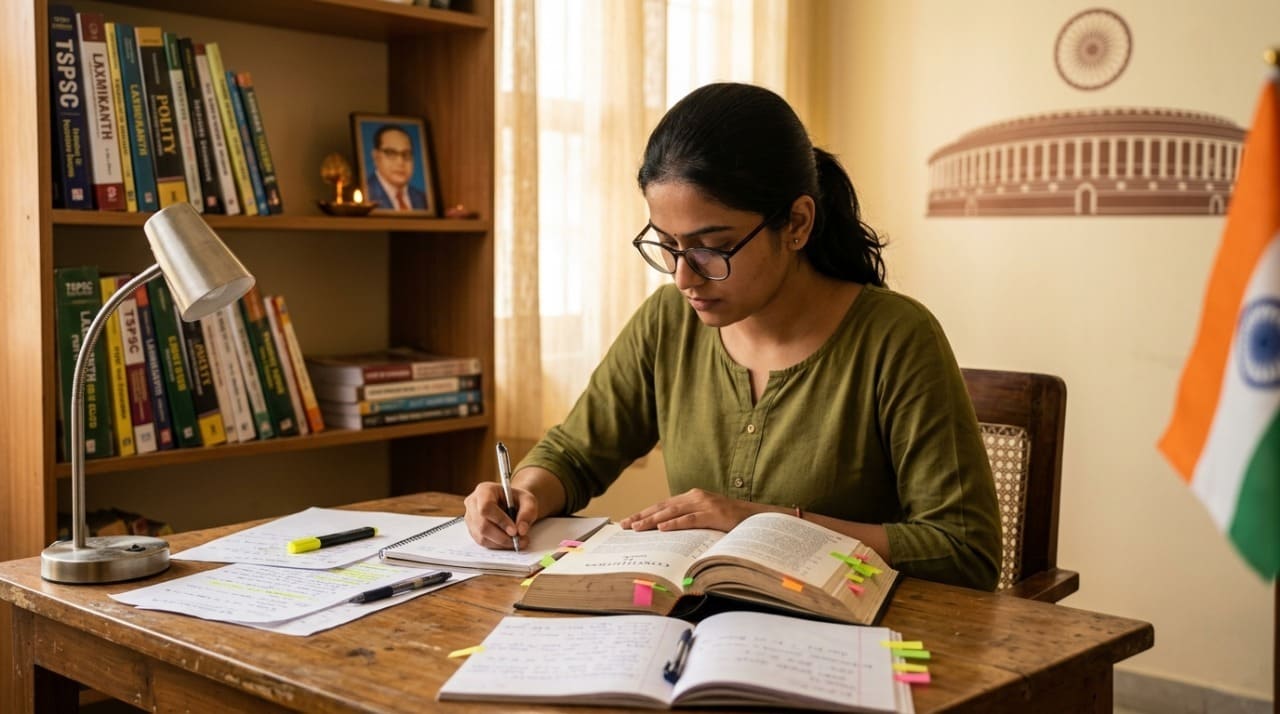
For many TSPSC aspirants, Indian Polity feels like a subject full of Articles, amendments, schedules, bodies, rights, duties, and landmark judgments. But here is the good news: you do not need to memorize the Constitution blindly. You need to understand the most exam-relevant Articles, connect them with real governance, and revise them in a smart, layered manner.
In TSPSC exams, especially Group 1, Group 2, Group 3, and other Telangana state-level competitive exams, questions from the Indian Constitution are usually direct, conceptual, or application-based. Articles are frequently asked because they form the backbone of Polity. If you know the important Articles clearly, you can answer many questions with confidence.
This blog is written like a practical classroom session. We will discuss the Top 20 Most Important Articles in the Indian Constitution for TSPSC, why they matter, what to remember, and how to revise them without confusion.
Why Constitution Articles Are So Important for TSPSC
Before jumping into the list, understand one thing clearly: Articles are not just numbers. Each Article represents a constitutional principle. For example, Article 14 is not just a number; it is the foundation of equality. Article 21 is not just a right; it is one of the most expanded and powerful rights in Indian constitutional law.
TSPSC often tests whether you understand:
- The meaning of important constitutional provisions
- The relationship between Fundamental Rights, Directive Principles, and Duties
- The powers of constitutional authorities
- The structure of Indian federalism
- The connection between Articles and current governance issues
So, instead of memorizing 395-plus Articles in a mechanical way, focus first on the high-yield Articles. Once these are strong, the rest of Polity becomes easier.
Top 20 Most Important Articles in the Indian Constitution for TSPSC
1. Article 1 – Name and Territory of the Union
Article 1 says that India, that is Bharat, shall be a Union of States. This Article is extremely important because it explains the basic political identity of India. For TSPSC, you should remember that India is described as a Union of States, not a federation of states. This wording is important because Indian federalism has a strong unitary bias.
When studying Article 1, connect it with the creation of new states, reorganization of states, and Telangana formation. Telangana aspirants should especially understand how state reorganization is linked with constitutional provisions.
2. Article 3 – Formation of New States and Alteration of Boundaries
Article 3 is a must-study Article for TSPSC because Telangana itself was formed through the constitutional process of state reorganization. This Article gives Parliament the power to form new states, alter boundaries, change names, and adjust areas of existing states.
For exam preparation, remember that a state legislature’s view is sought, but its consent is not mandatory. This point is frequently tested. Connect Article 3 with the Andhra Pradesh Reorganisation Act, 2014 and the creation of Telangana as India’s 29th state at that time.
3. Article 12 – Definition of State
Article 12 defines the term “State” for the purpose of Fundamental Rights. It includes the Government and Parliament of India, state governments and legislatures, local authorities, and other authorities within India or under the control of the Government of India.
This Article is important because Fundamental Rights are mainly enforceable against the State. TSPSC may ask what comes under “State” or why Article 12 is important in rights-related questions.
4. Article 13 – Laws Inconsistent with Fundamental Rights
Article 13 declares that laws inconsistent with Fundamental Rights are void to the extent of inconsistency. This Article gives real strength to Fundamental Rights because it prevents the State from making laws that violate them.
While revising Article 13, remember its connection with judicial review. Courts can examine whether a law violates Fundamental Rights. This Article is a bridge between rights and the power of the judiciary.
5. Article 14 – Equality Before Law
Article 14 provides equality before law and equal protection of laws. This is one of the most frequently asked Articles in competitive exams. Equality before law is a negative concept, meaning no special privilege. Equal protection of laws is a positive concept, meaning similar treatment in similar circumstances.
For TSPSC, remember that Article 14 allows reasonable classification but prohibits arbitrary discrimination. This Article is linked to administrative fairness, social justice, and constitutional morality.
6. Article 15 – Prohibition of Discrimination
Article 15 prohibits discrimination on grounds of religion, race, caste, sex, or place of birth. But it also allows special provisions for women, children, socially and educationally backward classes, Scheduled Castes, and Scheduled Tribes.
This is important for TSPSC because questions often test the balance between equality and protective discrimination. Do not think reservation is against equality. The Constitution allows positive measures to bring real equality.
7. Article 16 – Equality of Opportunity in Public Employment
Article 16 deals with equality of opportunity in matters of public employment. Since TSPSC itself is a recruitment-related exam, this Article has practical relevance. It ensures fair access to government jobs while also permitting reservations for backward classes under certain conditions.
When revising Article 16, connect it with public employment, reservation, merit, representation, and social justice. It is a high-value Article for both prelims and mains-style answers.
8. Article 17 – Abolition of Untouchability
Article 17 abolishes untouchability and forbids its practice in any form. This is a short Article but extremely powerful. It reflects the social reform vision of the Constitution.
For TSPSC, remember that Article 17 is an absolute provision and is linked with the Protection of Civil Rights Act, 1955. In essay or descriptive answers, you can use Article 17 as an example of the Constitution’s commitment to social justice.
9. Article 19 – Six Freedoms
Article 19 grants important freedoms to citizens, including freedom of speech and expression, assembly, association, movement, residence, and profession. This Article is one of the most dynamic parts of the Constitution.
For exams, remember that Article 19 is available only to citizens, not foreigners. Also remember that these freedoms are not absolute. The State can impose reasonable restrictions on specific grounds such as public order, security of the State, decency, morality, and sovereignty and integrity of India.
10. Article 21 – Protection of Life and Personal Liberty
If you ask any serious Polity teacher which Article deserves special attention, Article 21 will definitely be in the answer. It says that no person shall be deprived of life or personal liberty except according to procedure established by law.
Article 21 has been expanded by courts to include many rights such as the right to privacy, right to livelihood, right to clean environment, right to legal aid, right to speedy trial, and right to live with dignity. For TSPSC, Article 21 is important for both objective questions and analytical answers.
11. Article 21A – Right to Education
Article 21A provides free and compulsory education to children between 6 and 14 years of age. It was inserted by the 86th Constitutional Amendment Act, 2002.
For TSPSC, remember the age group clearly: 6 to 14 years. Also connect Article 21A with the Right of Children to Free and Compulsory Education Act, 2009. This Article is useful in questions related to education, welfare, child rights, and social development.
12. Article 25 – Freedom of Religion
Article 25 provides freedom of conscience and the right to freely profess, practice, and propagate religion. However, this right is subject to public order, morality, health, and other provisions of Part III.
This Article is important because it shows India’s secular character. In TSPSC preparation, understand that Indian secularism does not mean complete separation of religion and State. It means equal respect for all religions with the State having power to regulate secular aspects of religious practices.
13. Article 32 – Right to Constitutional Remedies
Dr. B.R. Ambedkar called Article 32 the heart and soul of the Constitution. It allows individuals to approach the Supreme Court directly for enforcement of Fundamental Rights.
For TSPSC, remember the five writs: Habeas Corpus, Mandamus, Prohibition, Certiorari, and Quo Warranto. Article 32 is itself a Fundamental Right. Without remedies, rights become only promises. This Article makes Fundamental Rights enforceable.
14. Article 36 to Article 51 – Directive Principles of State Policy
Although this is a range of Articles, TSPSC aspirants must treat Directive Principles as a major constitutional area. DPSPs guide the State in making laws and policies for social and economic justice.
Important DPSP Articles include Article 39, Article 40, Article 44, Article 45, Article 47, and Article 48A. For exam purposes, remember that DPSPs are non-justiciable, but they are fundamental in the governance of the country. In mains answers, DPSPs help you write balanced points on welfare state, social justice, environment, panchayati raj, and uniform civil code.
15. Article 51A – Fundamental Duties
Article 51A contains Fundamental Duties of citizens. These were added by the 42nd Constitutional Amendment Act, 1976. Later, one more duty relating to education of children was added by the 86th Amendment.
For TSPSC, remember that Fundamental Duties are inspired by the Constitution of the former Soviet Union. They are not directly enforceable like Fundamental Rights, but they are important for responsible citizenship. They are useful in questions related to civic sense, constitutional values, environment, national integration, and public property.
16. Article 72 – Pardoning Power of the President
Article 72 gives the President power to grant pardons, reprieves, respites, remissions, or commute sentences in certain cases, including death sentences and cases involving Union law.
For TSPSC, compare Article 72 with Article 161, which deals with the Governor’s pardoning power. The President can pardon death sentences, while the Governor cannot pardon a death sentence completely, though the Governor may suspend, remit, or commute in certain cases as per constitutional provisions and legal interpretation.
17. Article 110 – Money Bill
Article 110 defines a Money Bill. This Article is important because questions on Parliament often include Money Bills, Financial Bills, and Ordinary Bills. A Money Bill deals with matters such as taxation, borrowing of money, Consolidated Fund of India, and related financial matters.
Remember one key point: the Speaker of the Lok Sabha certifies whether a bill is a Money Bill. The Rajya Sabha has limited powers over Money Bills and can only make recommendations within the prescribed time.
18. Article 123 – Ordinance-Making Power of the President
Article 123 empowers the President to promulgate ordinances when Parliament is not in session and immediate action is needed. An ordinance has the same force as an Act of Parliament, but it is temporary.
For TSPSC, remember that ordinance power is not a substitute for regular law-making. It must be used under specific circumstances. Compare it with Article 213, which gives similar power to the Governor at the state level.
19. Article 226 – Writ Jurisdiction of High Courts
Article 226 gives High Courts the power to issue writs. This Article is very important because High Courts can issue writs not only for enforcement of Fundamental Rights but also for other legal rights.
Compare Article 226 with Article 32. Article 32 is for the Supreme Court and is itself a Fundamental Right. Article 226 is wider in scope because it covers both Fundamental Rights and other legal rights. This comparison is a favorite area in competitive exams.
20. Article 368 – Amendment of the Constitution
Article 368 deals with the power and procedure to amend the Constitution. This Article is crucial because it explains how the Constitution can change with time while preserving its basic structure.
For TSPSC, remember the concept of the Basic Structure Doctrine, developed by the Supreme Court in the Kesavananda Bharati case. Parliament can amend the Constitution, but it cannot destroy its basic structure. This topic is highly relevant for Polity, governance, and constitutional development.
How to Study These Articles for TSPSC Without Confusion
Many aspirants make one common mistake: they try to memorize Articles in isolation. That method works for a few days, but during revision everything becomes mixed up. Instead, study Articles in clusters.
Cluster 1: Union and Territory
- Article 1 – India as Union of States
- Article 3 – Formation of new states
- Connect with Telangana formation and state reorganization
Cluster 2: Fundamental Rights
- Article 12 and 13 – Foundation and enforceability
- Article 14 to 18 – Right to Equality
- Article 19 to 22 – Freedom and personal liberty
- Article 25 to 28 – Religious freedom
- Article 32 – Constitutional remedies
Cluster 3: Governance and Institutions
- Article 72 – President’s pardoning power
- Article 110 – Money Bill
- Article 123 – Ordinance power
- Article 226 – High Court writs
- Article 368 – Amendment procedure
Smart Memory Techniques for Articles
Do not depend only on repeated reading. Use active recall. Close the book and ask yourself: “What does Article 21 say?” “Which Article deals with Money Bill?” “Which Article allows Parliament to create new states?” This technique is far more powerful than passive reading.
Here is a simple revision method:
- Day 1: Read the Article and understand its meaning.
- Day 2: Write the Article number and provision from memory.
- Day 4: Solve 10 MCQs related to that topic.
- Day 7: Revise with comparisons, such as Article 32 vs Article 226.
- Day 15: Use the Article in a short answer or mains-style point.
Common Mistakes TSPSC Aspirants Should Avoid
Even hardworking students lose marks in Polity because of avoidable mistakes. Be careful with these:
- Confusing Article 32 and Article 226
- Forgetting that Article 19 is available only to citizens
- Assuming Fundamental Rights are absolute
- Mixing up President’s pardoning power and Governor’s pardoning power
- Reading DPSPs without remembering that they are non-justiciable
- Studying Articles without connecting them to current governance
How to Use These Articles in Mains Answers
If you are preparing for descriptive papers, these Articles can improve the quality of your answers. For example, if the question is about social justice, you can mention Articles 14, 15, 16, 17, and DPSPs. If the question is about environmental governance, you can mention Article 48A and Article 51A. If the question is about judicial protection of rights, you can mention Articles 32 and 226.
The best answers are not overloaded with Articles. They use the right Article at the right place. One accurate constitutional reference is better than five random Article numbers.
Final Mentor Advice: Make Articles Your Strength, Not Your Fear
Dear aspirant, Polity becomes easy when you stop treating it like a memory test and start treating it like a map of Indian democracy. Every important Article has a purpose. Article 14 protects equality. Article 21 protects dignity. Article 32 protects remedies. Article 368 protects constitutional flexibility while respecting the basic structure.
For TSPSC, your target should not be to show off how many Articles you know. Your target should be to answer questions accurately, eliminate wrong options quickly, and write mature answers with constitutional depth.
Start with these 20 Articles. Revise them repeatedly. Make a one-page chart. Practice MCQs. Use them in answer writing. Discuss them with friends. Within a few weeks, you will notice that Indian Polity no longer feels heavy. It starts becoming logical, connected, and scoring.
Remember, TSPSC preparation rewards consistency more than intensity. Study smart, revise regularly, and build conceptual clarity. These Articles are not just important for the exam; they are important for understanding how India governs itself and how citizens are protected under the Constitution.
Your next task: Take a notebook and write these 20 Articles from memory. Then mark the ones you are weak in. That simple exercise can show you exactly where your Polity preparation stands today.