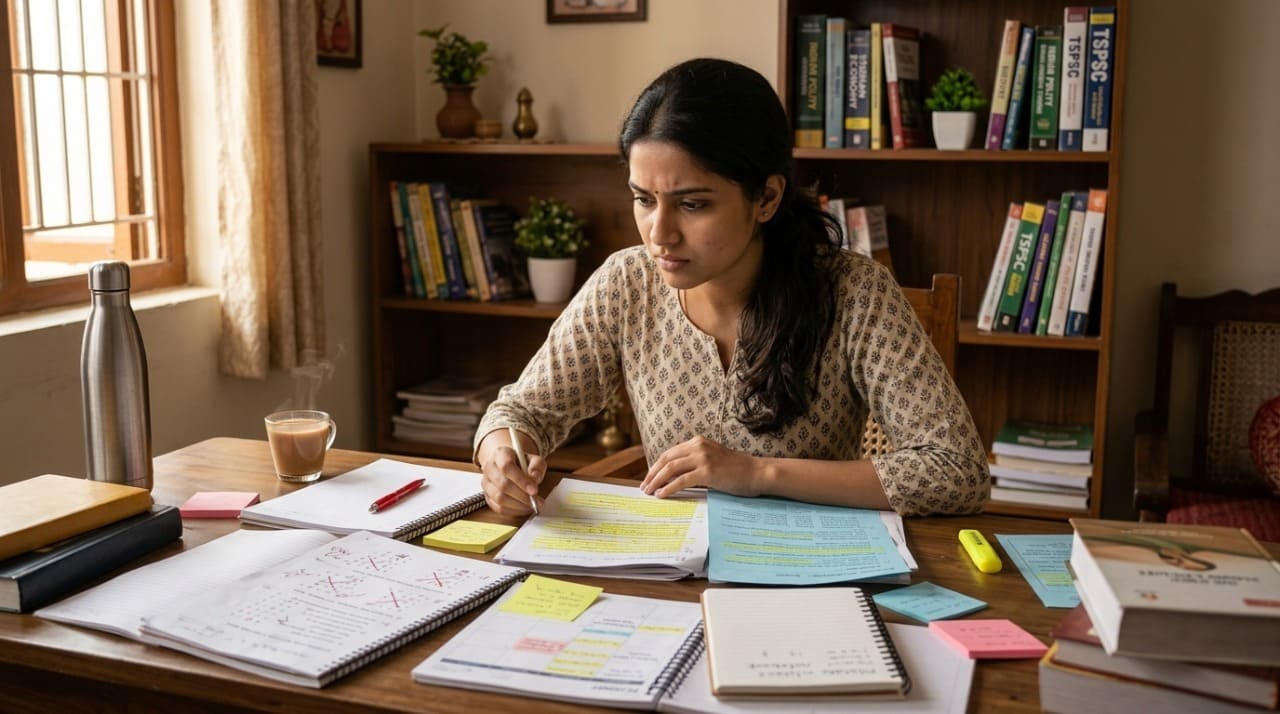
Every serious TSPSC aspirant knows the importance of studying. You buy standard books, attend classes, collect PDFs, prepare notes, watch lectures, and solve mock tests. But here is the truth many students realize very late: selection does not depend only on how much you study; it depends on how well you revise what you have studied.
Revision is where your preparation becomes exam-ready. Without revision, even the best notes become useless. You may feel that you have completed Indian Polity, Telangana History, Economy, Geography, Current Affairs, and General Science, but in the exam hall, the real question is simple: can you recall the right point at the right time?
Many TSPSC aspirants work hard for months but make serious mistakes during revision. These mistakes create confusion, reduce confidence, and lead to silly errors in the exam. The good news is that revision mistakes can be fixed quickly once you identify them.
In this blog, let us discuss the top 5 mistakes TSPSC aspirants make during revision and, more importantly, how to correct them with a practical strategy.
Why Revision Is the Deciding Factor in TSPSC Preparation
The TSPSC syllabus is broad. You have to cover Telangana history, Indian Constitution, Indian economy, Telangana economy, geography, environment, science and technology, current affairs, society, governance, policies, schemes, and mental ability depending on the exam. No aspirant can remember all this after reading only once.
Your brain forgets information naturally. That is not your weakness. It is normal. The only way to fight forgetting is through planned revision. A topic becomes strong only after repeated exposure, active recall, and practice-based revision.
Think of revision as the bridge between learning and scoring. Reading gives you knowledge. Revision gives you command. Practice gives you speed. Mock tests give you exam temperament. If revision is weak, the entire chain becomes weak.
Mistake 1: Revising Only by Reading Again and Again
This is the most common mistake. Many aspirants think revision means opening the same book or notes and reading the same lines again. This feels comfortable because the content looks familiar. But familiarity is not the same as memory.
When you read a topic again and again, your mind may say, “Yes, I know this.” But when you close the book and try to recall the point, you may struggle. This happens because passive reading creates recognition, not strong recall.
Example
You may read Article 21 multiple times and feel confident. But if someone asks, “What are the rights expanded under Article 21 through judicial interpretation?” you may not be able to answer clearly. That means the topic is recognized, but not mastered.
How to Fix This Mistake
Use active recall. After reading a topic, close the book and ask yourself questions.
- What is the main concept of this topic?
- What are the 5 most important points?
- Can I explain this in simple language?
- Can I write a short answer on this?
- Can I solve MCQs from this area?
For every revision session, follow this simple rule: read less, recall more. If you study for one hour, spend at least 20 minutes recalling without looking at the notes.
Practical Revision Method
- Read the topic for 20 minutes.
- Close the book.
- Write key points from memory for 10 minutes.
- Check what you missed.
- Mark weak points for the next revision.
This method may feel difficult initially, but it improves real exam performance. The exam will not show you your notes. It will test what you can remember under pressure.
Mistake 2: Revising Without a Proper Schedule
Many aspirants revise randomly. One day they revise Polity, the next day Telangana History, then they suddenly shift to current affairs, then after a week they remember Economy. This scattered method creates anxiety because there is no clear system.
Random revision gives a false feeling of productivity. You may sit for many hours, but you do not know whether the entire syllabus is being covered in a balanced way. Some subjects are revised too often, while difficult subjects are postponed again and again.
Why This Is Dangerous
In TSPSC exams, every subject matters. If you revise only your favorite subjects, your weak areas will pull down your score. Many students repeatedly revise Telangana History because they enjoy it, but avoid Economy or Science because it feels difficult. In the exam, the paper will not respect your comfort zone.
How to Fix This Mistake
Create a revision calendar. Your revision should be planned weekly and monthly. Do not leave it to mood.
A simple weekly revision structure can look like this:
- Monday: Indian Polity + 20 MCQs
- Tuesday: Telangana History + short notes revision
- Wednesday: Economy + current affairs linkage
- Thursday: Geography and Environment
- Friday: General Science and Technology
- Saturday: Current Affairs + schemes + reports
- Sunday: Mock test analysis and weak area revision
You can adjust this depending on your exam and stage of preparation. But the point is clear: every subject must return at fixed intervals.
Use the 1-3-7-15 Revision Rule
After studying a topic, revise it:
- After 1 day
- After 3 days
- After 7 days
- After 15 days
This spaced revision method helps your brain store information for longer. It is especially useful for factual subjects like Telangana history, constitutional Articles, schemes, geography facts, and current affairs.
Mistake 3: Ignoring Mistakes Made in Mock Tests
Mock tests are not just for marks. They are diagnostic tools. They show where your preparation is weak, where your concepts are unclear, where you are overconfident, and where you make silly mistakes.
Unfortunately, many aspirants write a mock test, check the score, feel happy or sad, and then move on. This is a big mistake. The real benefit of a mock test begins after the test, not during the test.
Types of Mistakes Aspirants Usually Make
- Knowledge mistake: You did not know the concept.
- Conceptual mistake: You knew the topic but misunderstood the question.
- Memory mistake: You had studied it but forgot the fact.
- Silly mistake: You marked the wrong option despite knowing the answer.
- Time pressure mistake: You rushed and made a poor choice.
If you do not classify your mistakes, you will keep repeating them. A topper does not simply solve more tests. A topper learns from every test.
How to Fix This Mistake
Maintain a mistake notebook. After every mock test, write down the questions you got wrong and the reason behind each mistake.
Your mistake notebook should have these columns:
- Question topic
- Correct answer
- Your wrong answer
- Reason for mistake
- Correct concept or fact
- Date of next revision
Before every new mock test, revise your previous mistake notebook for 20 minutes. This habit can improve your score faster than reading a new chapter randomly.
Important Rule
Do not feel bad about mistakes in mocks. Mistakes in mock tests are cheaper than mistakes in the final exam. Every corrected mistake is a future mark saved.
Mistake 4: Making Revision Notes Too Long
Some aspirants prepare revision notes that are almost as big as the original book. This defeats the purpose of revision. If your short notes are not short, they will not help you in the final stage.
Revision notes should be quick, sharp, and exam-focused. They should help you revise an entire topic in minutes, not hours.
Example
If you are preparing notes on the Gentlemen’s Agreement of 1956, do not rewrite the full story every time. Your final revision note should contain:
- Background: SRC, Vishalandhra demand, Telangana concerns
- Date: 1956
- Main aim: Safeguards for Telangana
- Key provisions: Revenue surplus, jobs, education, Regional Committee, cabinet representation
- Significance: Linked to Telangana movement
That is enough for quick revision. Details can remain in your main notes, but final notes should be compact.
How to Fix This Mistake
Use the 3-level notes method.
- Level 1: Full notes from class or textbook
- Level 2: Short notes for weekly revision
- Level 3: Ultra-short notes for final revision before exam
Your Level 3 notes should contain only keywords, dates, Articles, schemes, reports, formulas, and tricky facts. These notes are your final weapon before the exam.
Use One-Page Revision Sheets
For every major topic, prepare a one-page sheet. For example:
- Indian Constitution: Important Articles
- Telangana Movement: Chronology and committees
- Budget: Key numbers and schemes
- Economy: Basic terms and indicators
- Geography: Rivers, soils, climate, crops
One-page sheets reduce exam fear because they make the syllabus look manageable.
Mistake 5: Avoiding Weak Subjects Until the Last Moment
This mistake is very common and very dangerous. Students naturally revise subjects they like. If you are strong in Polity, you revise Polity again and again. If Telangana history feels interesting, you revise it repeatedly. But what about Economy, Science, Environment, or Mental Ability?
Weak subjects do not become strong automatically. They become weaker when you ignore them. The last month before the exam is not the right time to open a subject you have been avoiding for six months.
Why Aspirants Avoid Weak Areas
- The subject feels boring.
- The basics are not clear.
- Previous attempts created fear.
- Mock test scores are low in that subject.
- They do not know where to start.
The solution is not to wait for motivation. The solution is to break the subject into small parts.
How to Fix This Mistake
Use the 30-minute weak subject rule. Every day, spend at least 30 minutes on one weak area. Not three hours. Not full-day pressure. Just 30 minutes daily.
For example:
- Monday: Basic economy terms
- Tuesday: Budget and fiscal deficit
- Wednesday: Inflation and banking
- Thursday: Telangana economy schemes
- Friday: MCQs from economy
- Saturday: Revise mistakes
In one month, 30 minutes daily becomes 15 hours of focused improvement. That is enough to change your confidence in a weak subject.
Start With High-Yield Areas
Do not try to master everything at once. First cover the most exam-relevant areas. In every weak subject, identify high-yield topics and start there.
- Economy: Budget, inflation, banking, poverty, employment, Telangana economy
- Science: Basics of biology, health, environment, everyday science
- Polity: Fundamental Rights, DPSPs, Parliament, President, Governor, judiciary
- History: Telangana movement, Hyderabad State, socio-cultural movements
- Geography: Indian physical features, Telangana rivers, soils, irrigation, climate
Weak subjects become manageable when you stop seeing them as mountains and start treating them as small daily tasks.
Bonus Mistake: Not Revising Current Affairs Regularly
Current affairs cannot be revised one week before the exam. It needs repeated revision because facts, schemes, reports, appointments, awards, and state-specific updates accumulate quickly.
For TSPSC, current affairs should be revised weekly and monthly. Focus especially on Telangana government schemes, state budget, national policies, constitutional developments, economy updates, science and technology, environment, and important days.
Current Affairs Revision Strategy
- Prepare monthly notes.
- Highlight Telangana-specific points separately.
- Revise every Sunday.
- Solve monthly MCQs.
- Link current affairs with static subjects.
For example, if you read about a Telangana welfare scheme, connect it with social justice, budget allocation, target beneficiaries, and constitutional values. This makes your preparation deeper.
How a Good Revision Day Should Look
A balanced revision day should include a mix of memory, practice, and analysis. Here is a practical model:
- Morning: Revise one static subject topic
- Mid-morning: Solve 30 to 50 MCQs
- Afternoon: Analyze mistakes and update mistake notebook
- Evening: Revise current affairs or Telangana-specific topic
- Night: Quick recall of important facts, dates, Articles, and schemes
This kind of routine trains your brain for both accuracy and recall. Do not spend the whole day only reading. Mix revision with testing.
Final 30 Days Revision Strategy for TSPSC
In the final month, revision becomes more important than new learning. Your priority should be consolidation.
During the Final 30 Days
- Revise short notes repeatedly.
- Solve previous year questions.
- Attempt full-length mock tests.
- Analyze every mock seriously.
- Revise current affairs monthly compilations.
- Avoid starting too many new materials.
- Focus on accuracy and time management.
Do not collect new PDFs in the final month unless absolutely necessary. New material creates panic. Your existing material, revised properly, can bring better results.
The Right Mindset for Revision
Revision can feel boring because you are seeing the same topics again. But remember, repetition is not a waste. Repetition is how mastery is built. A cricketer practices the same shot thousands of times. A singer repeats the same notes. An aspirant revises the same facts and concepts until recall becomes automatic.
Do not chase the feeling of freshness all the time. Some parts of preparation are repetitive by nature. The student who accepts this calmly gets ahead of the student who constantly searches for new sources.
Your goal during revision is not to feel entertained. Your goal is to become accurate, confident, and exam-ready.
Final Mentor Advice
Dear aspirant, if you have studied sincerely but still feel underconfident, the problem may not be your preparation. It may be your revision system. Fix that system, and your marks can improve significantly.
Avoid passive reading. Follow a schedule. Learn from mock test mistakes. Keep revision notes short. Face weak subjects daily. These five changes can transform your TSPSC preparation.
Remember this line clearly: The exam does not reward the student who studied the most once. It rewards the student who revised the most intelligently.
Your next task is simple. Take one subject today and prepare a one-page revision sheet. Then close your notes and recall the key points aloud. That small exercise is the beginning of smart revision.
Revise with discipline. Revise with honesty. Revise like your future depends on it — because in many ways, it does.